University history
History of Zaporizhzhia Polytechnic. This page contains a chronology of the university's development: from the founding of a small mechanical and technical school in 1900 to a modern national institution of higher education.
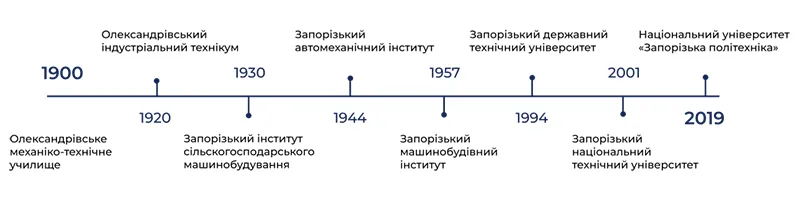
Through the corridors of history
Olexandrivsk Secondary Seven-Class Mechanical and Technical School (1900–1920)
The life of every team begins with the first step taken by enterprising people who decided to start a new business. For the team of the Zaporizhzhia Polytechnic National University (NU «Zaporizhzhia Polytechnic»), such a step and the beginning of the complex but bright history of the higher education institution was the organization on July 1, 1900 in the county town of Oleksandrivsk (since 1921 – the city of Zaporizhzhia) of a secondary seven-grade mechanical and technical school with a lower craft school attached to it. The activities of this school had a significant impact on the formation and improvement of Russian vocational education, and later contributed to the training of engineering personnel for Ukraine.
As is known, in the second half of the 19th century. economic development of Russia gained rapid pace. The coal, metallurgical, machine-building, light and food industries and agriculture developed intensively. The center of heavy industry moved from the Urals to the Donetsk-Kryvyi Rih region, where the main deposits of iron, coal and manganese were concentrated. This became a decisive impetus to the economic development of cities and villages.
According to the reforms of 1864, local (zemsky) self-government bodies were created, which practically completely took over the problems of the functioning of education. In the same year, Baron M. O. Korf (1834–1883) was elected chairman of the Oleksandrivka County School Board – a great scientist, the founder of zemsky public schools in the county and in southern Ukraine.
M. O. Korf and the zemstvo council focused a lot of attention on the issue of opening a technical educational institution in the city of Oleksandrivsk. After all, at the end of the 19th century in the South of Ukraine, in connection with the development of industry, railway transport and trade, there was a need to train specialists with secondary specialized education.
The issue of establishing the Aleksandrovka Mechanical and Technical School was a difficult and lengthy one. Starting in 1867, the Aleksandrovka Zemstvo Council and the city’s public repeatedly appealed to the tsarist government, but the government remained silent.
In the fall of 1895, the head of the industrial schools department, I. A. Anopov, arrived in Aleksandrivsk, who personally became convinced of the need to open a technical school with a seven-year course, to which an eighth grade could later be added, which would allow students to receive secondary education and would also open the doors to higher specialized educational institutions for them. On 5.10.1895, the city council, at an extraordinary meeting in the presence of I. A. Anopov, approved a petition to open a secondary mechanical and technical school in the city of Aleksandrivsk.
On August 12, 1896, the City Council allocated a plot of city land with a total area of four dessiatinas on Yarmarkova Street (since 1902 – Zhukovsky Street, since 2024 – Universytetskaya Street).
In 1899, at the request of the Ministry of Public Education, the State Council considered the issue of establishing a seven-year secondary technical school with a lower vocational school attached to it in the city of Oleksandrivsk. On March 29, 1899, the decision to establish the said institution from July 1, 1900 was approved by the emperor.
Almost a year before, according to the order of the public department dated August 18, 1899, N. F. Rudolf was appointed as the director of the school, a well-known engineer and teacher at the time, a graduate of the Moscow Technical School, who held the position of head of the Gomel Technical Railway School.
Arriving in Aleksandrovsk, N. F. Rudolf thoroughly familiarized himself with the affairs of the establishment of a secondary technical school in the city and the state of local industry. Together with the leader of the nobility of Aleksandrovsk district, Count I. V. Kankrin, they identified candidates for the commission for the construction of the school buildings. In October of the same year, N. F. Rudolf left for St. Petersburg and began drawing up a construction project.
On February 28, 1900, the scientific committee of the Ministry of Public Education reviewed the school construction project, the estimate developed jointly with the architect R. R. Marfeld, the facade and sections of the main building, as well as the details of the interior decoration of the recreation hall and lobby.
On March 21, 1900, the project and estimate were reviewed and approved for implementation by the Technical and Construction Committee of the Ministry of Internal Affairs. A tender was appointed for the execution of construction work by contract. According to the decision of the Ministry of Public Education, the school construction commission included: the school director (chairman of the commission) N. F. Rudolf, a representative from the city and the zemstvo, the city mayor Z. M. Makhno, the chairman of the zemstvo council P. P. Ivanytsky, the builder A. K. Gintse, representatives of the Ministries of Finance, Education, etc. A week later, the commission developed a program of priority work.
The construction season has begun. Completion of construction is scheduled for August 1, 1901. It was necessary to build a large building approximately 68 fathoms long and with a capacity of over 3,090 cubic meters within 16 months.
On April 2, 1900, N. F. Rudolf was transferred to a higher position in St. Petersburg – inspector for supervision of industrial schools of the Ministry of Public Education.
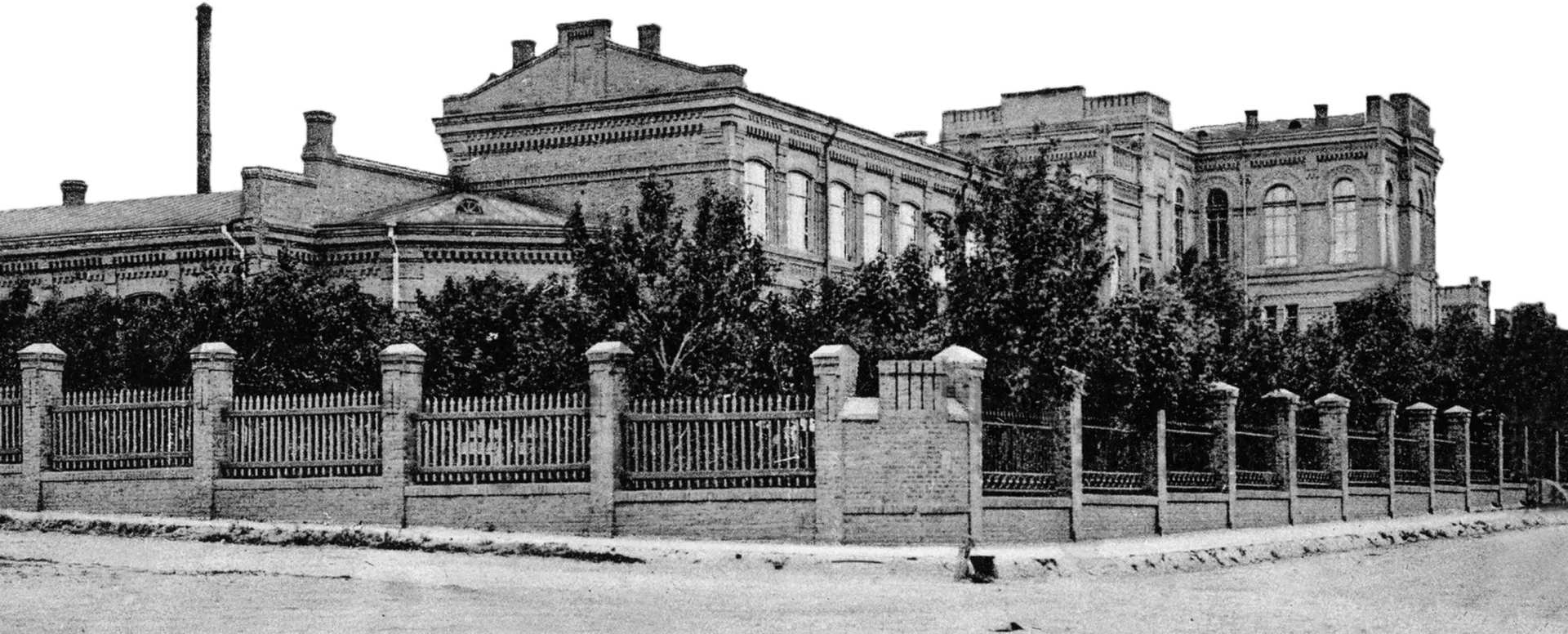
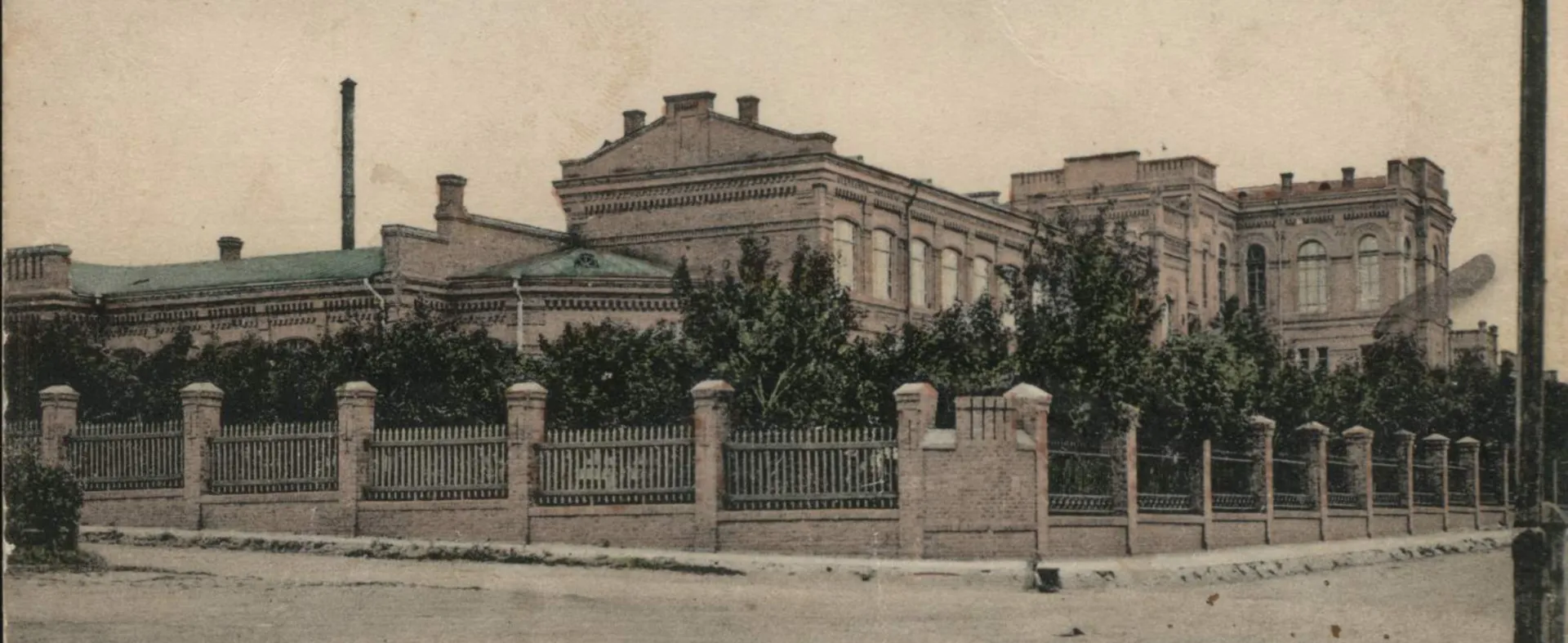
On June 1, 1900, D. M. Podderyogin, also a well-known engineer and teacher in the country, was appointed director of the school. Denys Nikolaevich coordinated the construction and made a lot of efforts to bring the premises into order within the specified time. The educational process was started long before the appearance of the main building – in the premises of the elementary school in September 1900. In a year and a half, beautiful two- and three-story buildings were built, which allowed classes to begin directly in the new school on August 15, 1901.
Classes and workshops were equipped with the latest equipment, desks were installed. The building had a particularly beautiful view from the Dnieper and the outskirts of the city. The main building housed eight classrooms, including those for drawing and painting, production workshops, a library, and on the third floor there was an assembly hall and a lobby.
The floors in the classrooms and offices were made of oak parquet, in other rooms – of metlaska tiles. The building was heated with stoves, electric lighting was installed. A residential building for teachers and employees was built next to the educational building. The school also had: a locksmith’s shop, a forge, a bathhouse, a power plant, and a shop.
A light wrought-iron lattice fence, brick sidewalks, and openwork gates were built around the school’s estate; low trees were planted: yellow acacia, lilac, barberry, wild cherry, and wild olive. The school was built mainly at state expense.
The Aleksandrovka Secondary Seven-Class Mechanical and Technical School trained high-class mechanical technicians for industrial enterprises. It accepted boys of healthy build, without physical defects: in grades 1–2 — not younger than 10 and not older than 14 years old, who had knowledge of the relevant course. Young men who graduated from the school received the title of technician, were granted the right to personal honorary citizenship, as well as the right to enter a higher technical school in the relevant specialty. From 5 to 8.10.1900, entrance exams were held for the first two classes. 192 applications were submitted. The pedagogical council accepted 72 people from among those who did not have threes. The solemn opening of the school took place on 5.11.1900. Classes were conducted by experienced teachers. D. M. Podderyogin knew how to select like-minded colleagues, attracting talented, qualified teachers to the school.
The curricula provided for a combination of technical and humanitarian education. Therefore, students acquired fundamental theoretical and practical knowledge – in history, geography, mechanics, physics, mathematics, geometry, electrical engineering, the basics of the resistance of materials, and the technology of metal and wood processing. The curricula included: the Law of God, chemistry, Russian and German, drawing, calligraphy, accounting, and singing. A fifth of the study time was allocated for work in workshops.
The mechanical, blacksmith, turning, carpentry, model workshops, as well as the engine department were equipped with new equipment, including foreign-made ones. Interestingly, the drawing class was designed according to the model of the Academy of Arts. The equipment for this was brought from Leipzig. The class had the shape of a tent, with side and overhead lighting. The interior was decorated with plaster figures of ancient gods. Each student had a shelf for models and a separate chair. Much attention was paid to conducting industrial practice. However, not all enterprises and factories could provide students with summer practice. Therefore, practical classes often took place in the school’s workshops, and excursions to factories were mandatory, especially during the technology course.
The purpose of the excursion was to show what the students could not see in their workshops, such as blast furnace, open-hearth and Bessemer production, rolling, central machines and channel furnaces, lifting devices, special machines, etc.
In the 4th grade, after completing a course in woodworking technology, students took two excursions – to a sawmill and to the woodworking departments of the Southern Railway workshops.
At the end of the school year, students in grades 6–7 studied metal technology and, in parallel with the course, visited local factories: Kop and Gelker Malleable Iron Plant; Ya. I. Badovsky Agricultural Implement Plant; Lepp and Valman Agricultural Implement Plant in the village of Shenvize and the village of Khortytsia. Each factory was visited twice a year.
All students were divided into groups. They wrote down their impressions in notebooks, where they also included diagrams and sketches of installations, machines, and machines. Within four days of their return, the students submitted a report to the teacher.
During the summer holidays, students went to the Oleksandrivsk school-farm for the deaf and dumb, where they got acquainted with various types of model farming, collected medicinal herbs. There was a small machine-building plant that produced agricultural implements, and there was even a printing house. The school had a pig farm, an apiary, a biological station, and other farm buildings.
Education and upbringing were carried out not only in classrooms and classrooms, but also outside them. Students went on archaeological and historical excursions to their native land – near the Dnieper and in the steppes. They organized walks along the banks of the Dnieper and Khortytsia, conducted excavations of burial mounds with the participation of historian and collector of local antiquities Yakiv Novytsky, collected collections of antiquities from burial mounds and their own homes, and recorded stories of local residents about the names of rocks and caves on the banks of the Dnieper and Khortytsia, associated with the names of Cossack heroes.
According to the plan of the Pedagogical Council, every year in May, country excursions to the Dnieper rapids were held, which corresponded to the course in physical geography and history. History, geography and physical education teachers, as well as medical workers, participated in the development of routes. The school had various interest groups: archaeological, historical, musical, and sports. Exhibitions of art paintings and students’ crafts were often organized.
In 1904, the school opened a local history museum, the first in the country. Sports competitions and holidays, as well as a game of gorodki (small town), were widely popular among students.
In May 1909, the school staff began the construction of a gymnastics pavilion on their own. And a year later it was solemnly opened. Since then, gymnastics has become a mandatory discipline at the school. Classes were conducted by specialists invited from Prague. Gymnastics festivals were held annually on the playground. An ice rink operated here in winter.
Over the past ten years, five graduations of the school have taken place, with 132 specialists. 80% of graduates have entered higher educational institutions of higher education. And all students of the first graduation have entered universities of the Higher Educational Institutions of Higher Education.
On February 6, 1911, the school held ceremonial events on the occasion of the 10th anniversary of the founding of the educational institution. Its program included: a speech by the director D. M. Podderyogin and reading of congratulations; a historical note on the activities of the technical school and the craft school, the speaker was the secretary of the technical school L. I. Yatsupov; a speech by teacher A. I. Rogovsky about the first car and the internal combustion engine; an anniversary cantata performed by the student choir; a folk song «Oh, meadow utushka», performed by the student choir. The ceremonial events were attended by the heads of the city council, representatives of public organizations of the Odessa educational district, heads of various institutions and educational institutions of Oleksandrivsk, students and their parents.
On December 4, 1913, the school was renamed «Olexandrivsk named after Emperor Mykola Alexandrovich Secondary Mechanical and Technical School with a Lower Craft School», and two years later, in December 1915, the emperor approved a description of new brand marks for students. On the cap is a gilded metal sign with a crown length of 4.5 cm. It consisted of a compass, an adjustable wrench, a hammer and a triangle; on both sides, the initials of His Imperial Majesty and the royal crown are depicted in gilding. On the collar of the jacket and blouse, on the buttonholes of the coat – the same brand mark, only smaller. 11 nominal scholarships of the emperor were approved for students.
In the second decade, the school continued to train technical specialists. From 1911 to 1916, 186 people received certificates of completion of the full course of the school, 70 of whom entered higher education institutions (hereinafter referred to as higher education institutions). In 1916, out of 26 graduates, 15 entered higher education institutions and a military school, four were drafted into the army, and 5 went to work in factories. The competition for school entrants was high — 4–5 applications for one place.
As of January 1, 1918, the school had 268 students. There were 20 teachers working, their average annual salary was from 3 to 5 thousand rubles. There were 84 students studying at the craft school. The fundamental and student libraries provided great assistance to the teachers in their scientific and educational work. The student library, headed by the teacher of the Russian language and mathematics O. I. Kalinin, had 2,683 books of 1,688 titles on January 1, 1916, mostly educational and fiction literature. All books were distributed to three age categories of students (junior, middle and senior). Books were issued once a week to each class, as well as on weekends and holidays.
The school introduced a mentoring system, full-time class mentors and their assistants worked in all study groups. These were experienced teachers: A. I. Rogovsky, F. N. Belyaev, G. Baran-Butovich, O. I. Kalinin, K. N. Trofimov, K. O. Milovydov, and others. Some of them worked part-time for an additional fee. Together with the students of the groups, they organized cultural and mass work and art exhibitions, conducted classes in clubs, excursions, showed concern for the students’ lives, visited apartments, and were interested in living conditions and amenities for classes.
At the end of the school year, group mentors reported in writing to the school council about student performance, missed classes, student discipline, and educational activities. Many mentors received thanks from the Minister of Education for their skillful organization of educational work in the group.
The school had its own outpatient clinic with instruments and medicines. Regular medical examinations and daily check-ups of all students were carried out: attention was paid to cleanliness and tidiness. A health certificate was issued for each student, where the doctor noted the state of health, visual acuity, body weight, etc. For physically weak students who did not have good health, special health camps were organized in the summer. Anti-alcohol and hygiene lessons were held for 7th grade students.
It is noteworthy that the school introduced permanent scholarships and assistance to students. Thus, a student paid 40 rubles per year for tuition, although the actual cost was 209 rubles, and for the full course of study – 1,566 rubles. The employees and service personnel of the school and their children were not forgotten. They all lived in apartments on the school’s territory. These were employees of the workshops, offices, a cleaner, a watchman, and a messenger. So that their children would not be left unattended and would not wander around the estate, a kindergarten and primary school were organized for them free of charge. Together with the students, they participated in the tree planting festival, took care of the trees and flowers.
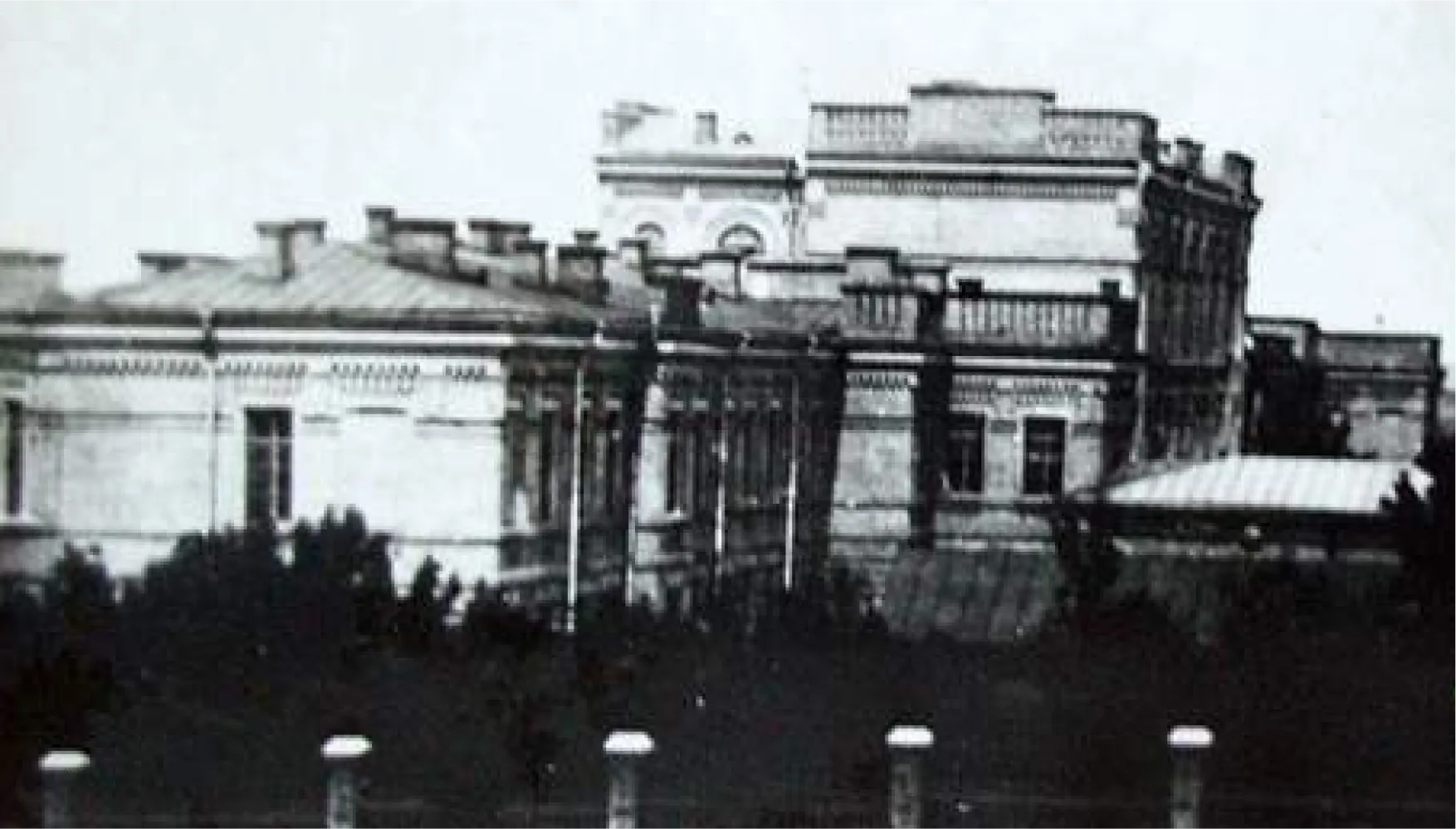
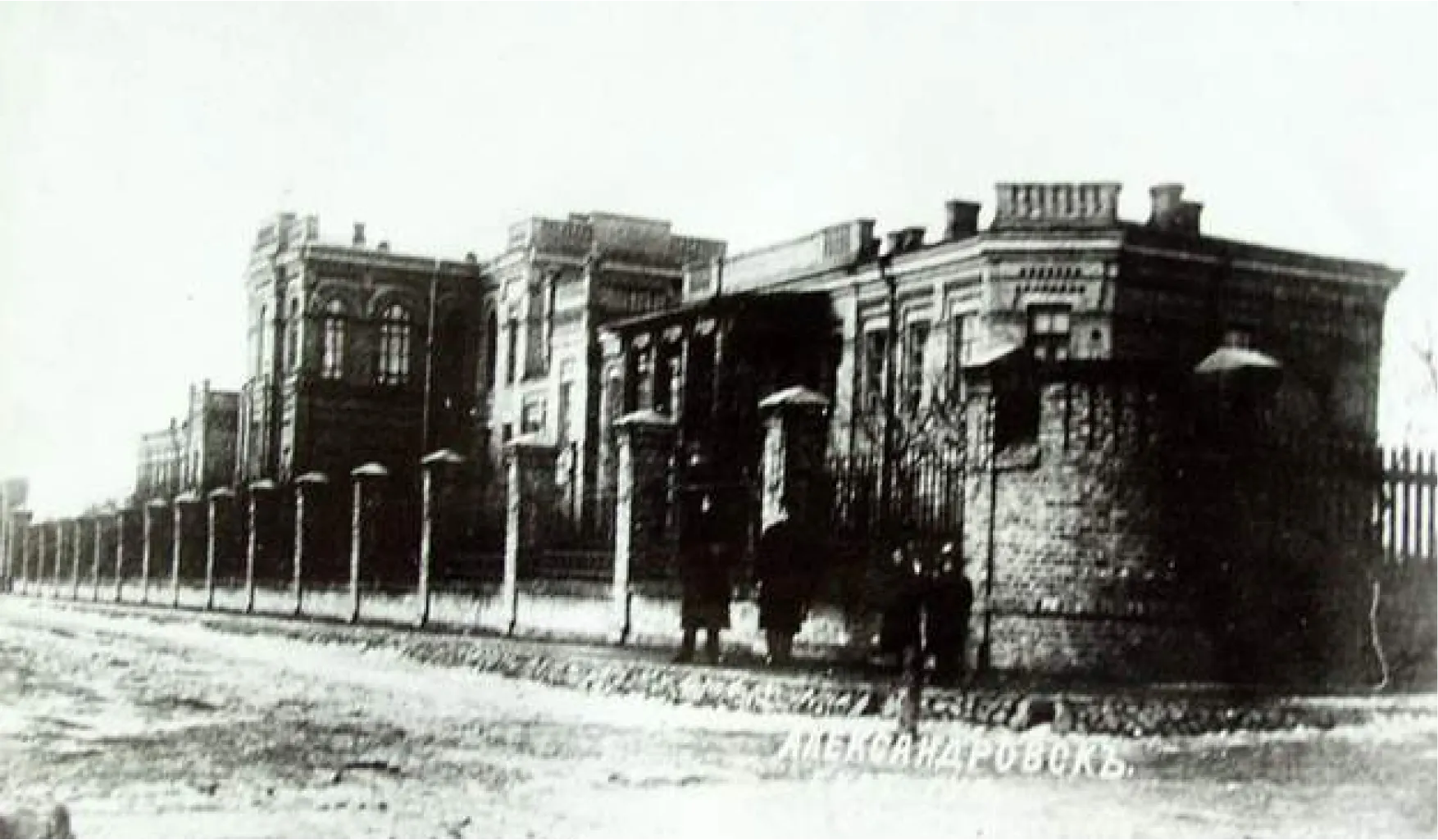
More graphic materials at link.
Industrial technical school with the rights of an institution of higher education (1920–1930)
On November 18, 1920, the Oleksandrivka Mechanical and Technical School was reorganized into a three-year industrial technical school (OIT) and a two-year mechanical and technical vocational school. The technical school had the rights of an institution of higher education. The technical schools admitted people with completed secondary education and graduated engineers in narrow specialties. A. M. Pavlyuk, who had previously been the director of the technical school (after the resignation of D. M. Podderyogin), was appointed director of the technical school (manager).
The technical school was supposed to train mechanical engineers for mechanical engineering. It had two special departments: industrial (mechanical, mechanical engineering) and agricultural (agriculture, mechanical engineering).
The enrollment of students was regulated by social status. More than two-thirds of the students came from working-class and peasant families. They had considerable production experience, but a low level of education.
The college’s activities began in very difficult conditions. At that time, the city was ruled by whites and reds, anarchists and various gangs. The school fully felt the tragedy of the civil war – robberies, pogroms. Valuable machines and equipment were taken from the school’s workshops, and a unique garden was predatorily cut down.
After the war, the technical school staff, with the help of the city and county councils, restored the carpentry and model workshops, mechanical locksmith shop, and blacksmith laboratory. Already in November 1920, classes began to be resumed at the school, mechanical and technical and craft vocational schools. Initially, the technical school had two classes (30 students), mostly staffed by students from the senior classes of the technical school.
One of the acute problems was the recruitment of personnel. The main staff of the school’s teachers was involved in the work at the technical school. Highly qualified teachers and educators remained here, such as Mykola Trofimov (teacher of mathematics, physics, natural sciences), Oleksandr Didenko (teacher of special disciplines, drawing), who in 1932 became an associate professor.
Former graduates of the Oleksandr Technical School A. A. Pakhuchy, A. F. Nozhkin, and others worked at the technical school. Gradually, the teaching staff was replenished with experienced specialists, such as L. I. Yatsupov, V. O. Yakson, G. I. Lepp, S. O. Soldatov, and P. V. Oliynychenko. The technical school, as in other educational institutions, had a collegial management structure — a council or committee headed by a director. Along with teachers, they included students and representatives of public organizations. The council elected a presidium of three people: the director and two assistants — heads of the educational part and the economy.
The educational process was continuous, without sessions or exams. Students received credits for completed programs and tasks on a three-point system: 3 – good, 2 – satisfactory, 1 – unsatisfactory.
According to the resolution of the Ukrgolovprofosvita, the educational process was divided into three trimesters – two winter and summer (six semesters). Winter: the first – from September 15 to January 1, with a break for two weeks (from January 1 to 15), the second – from January 15 to May 15, with a break for two Easter weeks. Summer: from May 15 to September 1, practice – eight hours a day, including up to four hours of lectures. The technical school developed its own three-year training programs in metal technology: in blacksmithing, foundry and a general course of machine tools.
The living conditions of students were very difficult. Tuition was paid — 30–50 rubles per year. It was also necessary to pay for accommodation in a barracks-type dormitory. Only two-thirds of students received a scholarship, which in 1927 increased to 31 rubles per month. The trade union executive committee, with great difficulty, sought opportunities to provide assistance to poor students, in particular, at the expense of funds from the profits of the production unit — workshops, which, on a contractual basis, fulfilled orders from various city organizations.
In 1924–1925, the technical school graduated: 15 from the industrial department, 7 from the agricultural department. All graduates of the technical school received diplomas and were sent to work at factories in Kramatorsk, Dnipropetrovsk, Zaporizhzhia, Nikopol, Odessa and other cities. The technical school had well-equipped teaching and methodological rooms. In 1924–1925, the classroom system was finally abandoned and the system of rooms was switched to, which were later reorganized into laboratories.
In the 1920s, a policy of Ukrainization was implemented in Ukraine, which also affected the Zaporizhzhia Industrial Technical School. Particular attention was paid to the study of the Ukrainian language by young people, future specialists. In 1925, 11 disciplines were already taught in Ukrainian at the ZIT, including «Applied Mechanics», «Fundamentals of Mechanical Engineering», etc. Since January 1926, three more subjects were transferred to teaching in Ukrainian. In 1926–1927, 16 courses were Ukrainized, and the last 4 subjects were transferred to teaching in Ukrainian in 1928–1929.
Students were involved in active life. The educational institution published a wall newspaper «Red Specialist». The technical school staff participated in the student congress, the elimination of illiteracy, and the fight against tuberculosis. Students led groups in workers’ clubs. The technical school had a local history and aviation group.
The best traditions of the school were continued in cultural and mass work. Vocal and musical evenings were organized in the assembly hall, a choir and a string orchestra performed, and festive events were held for holidays and anniversaries of writers, composers, and public figures, in which representatives of other educational institutions of the city also participated.
Students willingly went out on Saturdays, unloaded cars with coal, delivered it to the technical school, planted and pruned trees, repaired premises, etc.
In the late 1920s, the technical school was one of the best engineering educational institutions in Ukraine. On December 11, 1924, according to the Decision of the Presidium of the Ukrgolovprofosvity of the People’s Commissariat of Education of the Ukrainian SSR, the Zaporizhzhia Industrial Technical School was named after V. Ya. Chubar. As the chairman of the People’s Commissariat of the Ukrainian SSR and a graduate of the school, he visited the technical school in 1927.
On July 27, 1925, S.M. Lyovochkina was appointed acting director of the technical school. P.V. Oliynychenko also temporarily performed the duties of director. Since February 1928, the technical school was headed by N.S. Zaidel. Since 1924, ZIT has trained almost 600 engineers and many other specialists for the national economy. In 1928, ZIT operated: a mechanical construction school for 400 people, foreman courses, an evening work department, and a little later preparatory courses were opened. From January 1, 1929, tractor driver-mechanic courses were operating. But there was still a shortage of highly qualified technical specialists in the country. In the 1920s, technical schools provided their graduates with higher education. However, outside Ukraine, such diplomas were considered not university diplomas, which led to misunderstandings. All this decided the future fate of the technical school. On September 17, 1929, the Central Executive Committee and the Council of People’s Commissars of the USSR adopted the Resolution «On the Introduction of a Unified System of Individual Technical Education». The technical school was recognized as a secondary specialized educational institution. In Ukraine, the reorganization of technical schools-higher education institutions into institutes began.
Institute of Agricultural Engineering (1930–1939)
According to the Resolution of the RNK of the Ukrainian SSR of March 23, 1930, the Zaporizhzhia Industrial Technical School was renamed the V. Ya. Chubar Machine-Building Institute. From July of the same year, by Order of the People’s Commissariat of Education of the Ukrainian SSR and the Supreme Soviet of the Ukrainian SSR No. 514, it was reorganized into the Zaporizhzhia Institute of Agricultural Machine-Building, which was subordinate to the Soyuzsilmash association, the People’s Commissariat of Heavy Industry of the USSR, and from September 1933 – directly to the Main Directorate of Educational Institutions of the same People’s Commissariat. N. S. Zaidel became the first director of the Zaporizhzhia Institute of Agricultural Machine-Building.
At the end of 1930, the student body was completed. 342 students were enrolled in the 1st–3rd courses. Among them were workers — 258, peasants and their children — 29, employees and employees’ children — 52. Those who graduated from preparatory courses and vocational schools were enrolled in the student body without entrance exams. After graduating from the institute, students received a qualification in the specialty of mechanical engineer. Initially, there were four departments: agricultural, tractor, materials processing, and foundry. However, the tractor department was later liquidated.
As of July 1, 1930, the structure of the institute was as follows. The Faculty of Agricultural Engineering, where 278 students studied, including 196 in the first year; 56 in the second year; 26 in the third year. The 1929–1930 graduation year consisted of 38 people. 48 people studied at the full-time working faculty. A total of 326 people studied at both faculties. The institute trained specialists in agricultural engineering not only for the needs of Zaporizhzhia industry, but also for the industry of all of Ukraine.
The head of the educational part of agricultural engineering in 1930 was G. I. Lepp. The resistance of materials was taught by L. A. Unter, theoretical and applied mechanics by O. G. Didenko, and the economics of industrial enterprises by N. S. Seidel.
In 1931–1932, extensive construction work was carried out: a third floor was added to the second floor of the main building, which allowed the educational area to be increased from 4,801 to 6,113 m2. Two student dormitories with 11 living rooms each and a four-story building for the teaching staff with 16 apartments with a total living area of 1,223 m2 were built.
At the time of the reorganization of the technical school into an institute, there were two departments of agricultural engineering and tractor engineering, the latter, according to the Order of the People’s Commissariat of Education of Ukraine dated July 11, 1930, was transferred to the Kharkiv Automobile and Tractor Institute of the State Automobile and Tractor Engineering Committee in September 1930.
The following year, two departments were created – production and design. The production department combined the foundry, blacksmithing and mechanical and technological specialties, and the design department – tillage and harvesting machines. But the structural changes did not end there. In 1934, two faculties were created: general technical, headed by Dean O. I. Gurvych, and a special one, subordinate to the educational part. A few years later, this faculty was renamed mechanical and technological (Dean M. O. Govorov). The faculty of agricultural engineering was also created. The profile of the institute was quite clearly defined in 1932. The training of engineers in the following specialties began: «Agricultural machinery», «Machine tools, tools and mechanical processing of metals», «Foundry machines». Thus, already at that time the institute became a machine-building institute, in which agricultural engineering was only one of the specialties.
In 1931, the evening department began operating, which accepted approximately 150 students, as well as the correspondence department, where classes started on February 1, 1931. Its students were employees of agricultural machinery factories. The term of study for correspondence students was two to three years.
During 1931–1934, the institute had a postgraduate program. Already in June 1931, 10 people were studying in the postgraduate program, including: D. G. Borisenko, G. O. Yakovenko, D. G. Terekhov and others. In 1931, the reorganization of old laboratories continued, and new ones were created – chemical and mechanical. The laboratory of agricultural machinery was replenished with modern equipment, the scientific library of the institute was expanded. A reading room for students and lecturers was opened. The student contingent was over 1,000 people.
The transition of many students from industrial work to study raised the question of their financial security. The majority received a scholarship, which was assigned in a differentiated manner – for singles, families and those with many children. Increased scholarships were provided to those contracted by enterprises and to representatives of other economic and trade union organizations. The institute regularly published a large-circulation newspaper «Student-Udarnyk», which became an active assistant to the directorate in the educational process.
From November 10, 1932 to 1935, the director of the institute was F. Y. Filatov, and from March 1935, L. G. Isakov, who had previously worked as the director of the Alumina Plant of the Dnipro Aluminum Combine.
In 1933–1934, new departments were created at the institute: agricultural mechanical engineering (head of the department V. Ya. Kallyus); power engineering (D. I. Endronkin); iron foundry production (Yu. A. Tomin); forging, stamping and pressing production (P. O. Yakelevich); metal cutting (V. P. Ilyashenko); physics and mathematics (V. A. Zhurbytsky); socio-economic disciplines (F. Y. Filatov); applied mechanics (O. I. Gurevich); strength of materials and machine parts (O. I. Gurvych).
The preparation of applicants in 1936–1937 was carried out with great difficulty. Rumors of the institute’s liquidation had a negative impact. The country took a course towards the liquidation of young institutes. The Main Directorate of Educational Institutions of the People’s Commissariat of Heavy Industry stopped allocating funds for construction in higher education institutions, reduced funds for textbooks, manuals and equipment. Another problem was the high staff turnover, which was caused by political and everyday reasons. N. S. Zaidel, F. Y. Filatov, F. V. Nikolaev, M. I. Gordon and others were branded as «evasive and Trotskyists». In 1937, two professors and two associate professors remained at the institute, and even they did not have a scientific degree. In the same year, the voice of the institute’s multi-circulation magazine «Student-drummer» fell silent.
Soon the ZHE switched to a system, the constituent elements of which were lectures, practical classes, tests and examination sessions. From March 1, 1933, the institute introduced military training for students.
The basics of production and engineering were mastered in the institute’s laboratories and workshops. But the main practical base was the Kommunar, Rostsilmash, Saratov Combine Harvester Plant, Kharkov Tractor Plant, and Kramatorsk Heavy Engineering Plant. First-year students underwent introductory practice as workers, and after the third year they worked as assistants to foremen and foremen. In their free time, student assault squads went to eliminate production breakthroughs at enterprises and buildings in the city. They built the institute’s auditoriums, dining hall, and dormitory. Students declared a technical approach to science. Approximately 40 students became leaders of technical circles and supervised rationalization groups at factories. Enriching their knowledge at the institute, they passed it on to workers. Students assisted the factory youth in improving their general education level, preparing them for entry into specialized educational institutions, and participated in sowing campaigns and harvesting as drivers, combine operators, and mechanics. Their experience, comments, and suggestions were taken into account when improving the combine harvester at Kommunar.
Amateur art became very popular, and evenings of relaxation were held twice a month. There were musical groups – a brass band, an ensemble of folk instruments, as well as drama groups, and their performances at student evenings were always interesting. Every year, excursions were held to the Crimea, the Caucasus, Askania-Nova, and a boat trip along the Dnieper. The institute was a regular participant in city amateur art reviews. Sports and defense-mass work were staged in an exemplary manner. At that time, everyone was fascinated by athletics, volleyball, tennis, and shooting sports. Parachuting lessons were widespread. Instructor V. Vasiliev, later an aviation general, became an enthusiast of this business.
During the summer, students worked on a subsidiary farm, where they grew grain and vegetable crops, looked after cattle and pigs. This was a significant help for the institute’s food supply. The subsidiary farm had 140 hectares of land. The institute was fully self-sufficient in grain and 70% in vegetable crops. The subsidiary farm kept 5 horses, 16 cattle and 29 pigs. 25,000 rubles were allocated for its needs. The students built a vegetable storage, a cellar, and prepared containers for salting vegetables. The bulk of the products went to the student and faculty canteens. Part of the dairy products was distributed among teachers and sick students.
They provided assistance to the best students, especially on holidays, and gave out prizes: coats, watches, a piece of silk for a dress, 200 rubles, subscriptions to the technical library, and a cultural trip to the theater. Prizes were also given to teachers: radio receivers, cameras, hats, writing instruments, and money. Research work also had a practical production orientation. In the first years of the institute, its organization experienced many difficulties. Among them: a weak laboratory base for experimental work, an insufficient number of professors and teaching staff, and, as a result, an overload with educational work.
To improve the level of educational and scientific work, a powerful material and technical base was needed. The institute staff reorganized old and created new laboratories and classrooms on their own. Zaporizhzhia factories, such as Zaporizhstal, Kommunar, and the Baranov Plant (now Motor Sich OJSC), provided great assistance in this. By 1940, the institute already had 11 laboratories and 9 classrooms, and production training workshops. The following laboratories functioned: agricultural machinery, strength of materials, applied mechanics, machine parts, foundry production, metal cutting and measuring devices and instruments, physical chemistry, electrical engineering, metallographic, and X-ray laboratories for structural analysis and translucency of metals. Over the decade, the book collection of the institute library increased more than ninefold (from 6,400 to 59,000 books).
In the last pre-war years, the receipt of state funds for science significantly increased. If until 1935, state budget funding for research was absent at all, and during the first two years from the beginning of funding, that is, in 1935 and 1936, it amounted to 10.5 thousand rubles per year, then in 1937 it increased more than threefold – to 34 thousand rubles, and in 1938 – 55.9 thousand rubles, in 1939 – 82.3 thousand rubles, and in 1940 – 82.5 thousand rubles. Accordingly, the number and volume of scientific research works increased, many of which were carried out on orders from enterprises. Naturally, the main directions of scientific research were determined by the profile of the institute and Zaporizhzhia enterprises: agricultural machinery, metallurgy, etc. Research work was actively carried out at the departments of agricultural engineering and iron and blacksmithing. The best students were also involved in research work. All this, of course, contributed to the growth of the level of educational and scientific work. In 1940, the teaching staff increased to 40 people. Research work was carried out on 20 topics.
In 1939, the institute was subordinated to the People’s Commissariat of Medium Machine-Building of the USSR and renamed the Zaporizhzhia Machine-Building Institute. The Statute of the Higher Educational Institution was adopted, approved by the All-Union Committee for Higher Education. Over the ten pre-war years, the institute gave life to 782 engineers, many of whom became heads of enterprises, designers, and statesmen, who were awarded orders and medals.
The Institute during World War II
The beginning of the Soviet-German war in June 1941, which was part of World War II, became a tragic moment in the history of the institute. A significant part of the teachers, staff and students went to the front. More than 600 students and teachers were mobilized into the army. Many of them were enrolled in military academies, schools, officer training schools, and became officers of the Soviet Army. Tomorrow’s graduates already knew the technique well, were ideologically and morally prepared. They had to study at an accelerated pace. This was required by wartime. In almost all branches of the military one could meet the graduates of the educational institution – artillery and tank units, aviation and communications, cavalry, and the navy.
Colonels Oleksii Paramonov and Oleksii Kozlykin rose from private to regiment commander, while Major Vasyl Trifonov, Captains Volodymyr Konstantinov and Andriy Kachurovsky rose to chiefs of staff. More than 400 former students, teachers, and employees of the educational institution were awarded orders and medals for their heroism and courage in the fight against Nazism.
On August 18, 1941, the Nazis managed to break through to Zaporizhzhia and capture the right-bank part of the city. In August 1941, the Zaporizhzhia Machine-Building Institute, by the way the only one among the higher education institutions not only of Zaporizhzhia, but also of the entire Zaporizhzhia region, was evacuated and did not remain in the territory occupied by the Nazis. After searching for a suitable place, the institute was located in the city of Barnaul (Altai Krai, Russia). Several dozen teachers and students left. They took with them part of the educational equipment, the necessary textbooks. The path was not easy, under enemy fire. Of the 34 teachers who left for the new place, only 12 arrived, among whom: L. G. Isakov, M. O. Govorov, A. I. Gurvich, V. P. Ilyashenko, L. P. Leonov, V. P. Solyanyk. On the way, some of the teachers voluntarily reported to the military enlistment offices and were sent to the front and military factories.
On February 23, 1942, classes began with 20 students, taught by 12 teachers who arrived from Zaporizhzhia. Classes were held in the harsh Siberian frosts in an unheated, unfinished building of a former school, which had just been vacated by the hospital.
At the beginning of 1942–1943, 12 departments were created, 484 students studied, but their composition changed frequently. Students did not have privileges, armor, they were drafted into the ranks of the Soviet Army. At the end of the academic year, 211 students remained, of which 155 were in the first year, 13 in the second, 30 in the third, and 13 in the fourth.
Student life was difficult. The institute was located in a small four-story building. Students lived mostly in private apartments. Only 55 graduating students were accommodated in a dormitory. There were not enough textbooks and visual aids. Students were served by a branch of the city scientific library. The educational and production base was also poor. Industrial practice was carried out at the Altai Tractor Plant in Rubtsovsk. The plant was still in the pre-commissioning period, a number of workshops were not working. The railway workshops of the depot of the station «Barnaul», which were provided for students’ classes, came to the rescue.
It was difficult to find food and fuel, there were power outages, and household issues were unresolved. There was a lack of warm clothing, shoes, and bedding. They overcame the difficulties themselves. They organized a workshop for sewing shoes, hats, fur sets, and mittens. The students themselves harvested firewood and coal. The institute had a subsidiary farm, a land plot of up to 60 hectares, where they grew potatoes, vegetables, and grain crops. They helped collective and state farms with harvesting and harvesting firewood for enterprises, schools, and hospitals.
Many scientists of the institute have successfully conducted scientific research on defense industry topics. The head of the Department of Strength of Materials, Prof. A. I. Gurvich, made calculations on shock loads of aircraft engine parts, the head of the Department of Machine Parts M. O. Govorov, completed a project of a machine tool for mechanical processing of car bodies. The heads of the departments worked on defense topics: mechanical engineering technology — Assoc. Prof. V. P. Ilyashenko, energy and motor transport — Assoc. Prof. I. V. Varshavsky, chemistry — Assoc. Prof. V. N. Babun, etc.
The institute’s teachers carried out extensive and meaningful work with students and the region’s population during extracurricular hours. The teachers of the Marxism-Leninism Department (head of the Department Zazh) supervised the work of student political clubs, scientific circles, issued wall newspapers, and actively gave lectures on issues of domestic and foreign policy to the working people of the city and region, in hospitals.
The staff of the Department of Mechanics (Head of the Department Prof. N. Nathanson) organized a Sunday university for students and high school students, where lectures were given on technical, general education and political topics. The staff of the institute sought to help the front in every way they could. Teachers and students transferred money to the defense fund, sent warm clothes and gifts to front-line soldiers.
In April 1943, the first graduation of students during the war took place. 13 students received an engineering diploma, 2 of them with honors (A. V. Zubrylina and A. A. Erdeli). In 1944, 4 engineers graduated.
In 1943, after the liberation of Zaporizhzhia from the Nazis, all the buildings of the institute were in ruins, equipment worth 1 million 80 thousand rubles was destroyed. All Zaporizhzhia residents unitedly took up the revival of the ZHE. They gradually repaired the premises and equipped the institute with equipment.
On March 27, 1944, the institute began operating. An Order of the People’s Commissariat of Medium Machine Building of the USSR was issued on the beginning of the institute’s work, and on July 31, by order of the same People’s Commissariat, its name was changed. It became known as the Zaporizhzhia Automechanical Institute of the NKSM. Some of the teachers did not return from the evacuation, they remained in the city of Barnaul to work at the Altai Machine Building Institute, the first higher education institution in the region, created thanks to the evacuation of the Zaporizhzhia University, among them was the director of the institute, L. G. Isakov.
On August 28, 1944, according to the relevant order for the Zaporizhzhia Automechanical Institute, entrance exams began. Classes started on October 1, 1944. 225 people studied in the first year, 41 in the second, 17 in the third, 15 in the fourth, and 13 in the fifth, a total of 311 students. The institute was staffed with teaching staff. M. Y. Bodzych was appointed director of the institute by the Order of the National Council of the Ukrainian SSR dated November 10, 1944.
For more than 12 years, Manuil Iosypovych headed the institute. In the difficult conditions of the post-war period, he did a lot to restore buildings destroyed during the war, select qualified teaching staff, establish and improve the educational process, and scientific activities.
Pre-war students and teachers, veterans of the Higher Educational Institution M. O. Govorov, V. I. Ilyashenko, V. V. Martynenko and G. A. Yakovenko returned to the institute. The departments were headed by experienced specialists Yu. A. Shchulte. P. M. Kichayev. G. A. Hovhannesov and B. S. Natapov. I. G. Shevchenko and G. M. Malchenko, who were released into the reserve, were involved in pedagogical activities.
Restoration and further development of the institute in the post-war years: from ZAMI to the media
Pre-war students and teachers, veterans of the Zaporizhzhia Automechanical Institute M. O. Govorov, V. I. Ilyashenko, V. V. Martynenko and G. A. Yakovenko returned to the Zaporizhzhia Automechanical Institute. The departments were headed by experienced specialists Yu. A. Shchulte. P. M. Kichayev. G. A. Hovhannesov and B. S. Natapov. I. G. Shevchenko and G. M. Malchenko, who were released into the reserve, were involved in pedagogical activity. Two faculties functioned at the institute: mechanical and technological and auto-tractor (deans – M. O. Govorov, M. F. Skalozub). Ten teachers had scientific degrees and academic titles.
Despite the heavy academic and social workload, the teachers focused a lot of attention on research work. During 1945–1946, 3 topics were completed, 14 were in the final stage. The departments of the institute maintained scientific ties with the USSR Academy of Sciences and the Ukrainian SSR Academy of Sciences; with research institutes and individual scientists. 40 scientific works of teachers were published. A number of teachers worked on candidate and doctoral theses.
In addition, the departments provided assistance to the teams of the city and regional factories. In particular, the Department of Metal Technology constantly conducted consultations on metallurgy and heat treatment for the Baranov and Voikov factories, and the Kommunar plant. Teachers of the Department of Machine Parts consulted with employees of the Zaporizhstal plant.
The composition of the student body has changed significantly, the majority of which have become participants in World War II. Yesterday’s fighters in military uniform have begun training to become qualified specialists.
Many war participants were also among the institute’s employees. These were laboratory assistants of the departments Borys Smagin, Serhiy Sava, Serhiy Tarakanov, Hryhorii Pogarsky, employees of the administrative and economic part Hryhorii Kosach, Ivan Pashkov, Hryhorii Pashik, Pylyp Prytula, Anatoliy Savchuk, and others.
The educational process had to be established in difficult conditions. Classes were held even in the corridors of the main building and in the barracks. There were not enough tables and stools. Students sat on blackboards set on bricks. They themselves prepared the classrooms for classes, repaired the furniture. As of September 1, 1945, 9 classrooms, 4 laboratories, 3 common rooms and one for drawing, 6 offices with a total area of 853 m2 were prepared, 12 classrooms were repaired, 123 classroom tables, 266 stools were made. Electric lighting was installed in all the rooms of the institute, 100 stoves were installed in the classrooms. The yard was landscaped, sports grounds were equipped, 250 trees and 500 bushes, as well as flowers were planted.
Many difficulties arose due to the lack of living conditions. There were no dormitories. Students rented corners in private apartments. The institute rented 1093m2 from the private sector for a dormitory and accommodated 140 students. The institute’s dining room, where students ate with coupons, was also a club. They had their own shop, laundry, hairdresser, shoe and sewing workshops, and a mutual aid office.
The year 1945 came, which brought the long-awaited victory over the Nazi invaders. The team focused a lot of attention on the quality of student recruitment. Comprehensive agitation work bore fruit. At the beginning of the first semester of 1945–1946, 415 students were already studying at the institute, and at the beginning of the second semester — 488.
The winter session consisted of 344 people: 1st year – 199, 2nd year – 69, 3rd year – 42, 4th year – 15, 5th year – 19. At the same time, 321 students successfully passed the session, including 19 with «excellent» and «good», 12 were expelled for failure.
Studying at the institute was not easy. Due to the lack of classrooms, lectures were given in streams consisting of six to seven groups, up to 150 people. The institute worked in one shift, from 8 a.m. to 1–3 p.m. The corridors of the former building were adapted for classrooms. The weekly workload of students was 40 hours, but in some cases it reached 44 hours. There was a shortage of textbooks, an average of seven copies were issued per group. There was a particular shortage of textbooks on the theory of machines and mechanisms, political economy, and other disciplines.
At the beginning of 1945–1946, an evening department began to operate, with 29 students.
The expulsion of students from the first years and from the evening department forced the management of the ZVO to take care of opening a preparatory department. Already on July 20, 1946, six groups with a total of 146 people were studying here.
Despite the lack of food and heavy workload in studies, students actively engaged in physical education and sports. The sports society «Torpedo» united 187 people. The first sports achievements appeared. Thus, the football team took 2nd place in the city championship, the volleyball team – first, and the women’s team – third. At the shooting competitions in 1946, the institute team took 2nd place.
In 1947, a small room with a stone-brick floor was used for physical education and sports, and the sports equipment in it could not fully ensure the implementation of the educational process and mass sports work, especially in the winter. The students restored the physical education center, which had a basketball court and two volleyball courts, and a diving hole. In 1947, the department of physical education and sports was created at the institute, which significantly improved the educational process and contributed to new achievements in sports.
In 1945–1946, the institute already had 19 departments. Thus, the Department of Strength of Materials was headed by G. A. Hovhannesov; the Department of Automobiles and Tractors was headed by M. I. Bodzych, who was also the director of the institute; the Department of Metal Technology and Metallurgy was headed by B. S. Natapov; the Department of Foundry was headed by Yu. A. Schulte; the Department of Foreign Languages was headed by L. A. Bogdanov. Out of 49 teachers, 10 had scientific degrees and academic titles. As of January 1, 1948, the ZHE had 15 laboratories, 6 classrooms, a library, and 3 training and production workshops in which students underwent practical training.
According to the Resolution of the Ministry of Higher Education of the USSR No. 32/m of September 20, 1947, the Zaporizhzhia Automechanical Institute was renamed the Zaporizhzhia Institute of Agricultural Machine Building. At the beginning of 1947–1948, almost 700 students studied at the institute’s three faculties, including 330 at the Faculty of Automobile and Tractor Engineering, 301 at the Faculty of Agricultural Machine Building, and 62 at the Faculty of Foundry Production.
Taking into account the needs of local and republican industry, in 1947 the Faculty of Foundry Production was opened at the university, which in 1948 was renamed the Faculty of Foundry Production Machines and Foundry.
The expansion of the scope of training specialists for the national economy required an acceleration of the pace of reconstruction work. In 1947–1948, the institute was replenished with valuable instruments, and laboratories were created: foundry production, electrical equipment, automobiles, and agricultural engineering. The laboratories of metallurgy and strength of materials were enriched with new instruments, manuals, and equipment.
In order to improve the level of specialists, significant attention was focused on the production and educational and production practices of students, which took place in the educational and production workshops of the institute. The practice of students of the second semester in the basics of foundry production was carried out at local factories. Students also underwent production practice at the ZIS, GAZ, Dnipropetrovsk and Ulyanovsk automobile plants.
On the initiative of public organizations, with the active assistance of teachers, student scientific and technical circles were created at the departments. In 1946–1947, 10 such circles operated at the departments of strength of materials, descriptive geometry, machine tools and tools, etc.
In 1948, a scientific student society was created at the institute, which included 250 students and 35 faculty members.
A new phenomenon in the educational process was that, starting in 1949, the admission of first-year students was carried out on a competitive basis. 329 applications were received for 200 places. 17 excellent students were accepted without exams. In general, first-year students had good preparation, which they confirmed during the sessions. Thus, for the first semester of 1949–1950, the average score of first-year students was 4.15, while in 1948–1949, it was only 3.70.
In the 1950s, the training of engineers intensified. Specialists were trained at an accelerated pace without being separated from production. For students who studied under this system, favorable conditions were created in production, they had practice at the workplace, if possible, they moved to work in their chosen specialty. Since 1952, the entrance exam in a foreign language was canceled for all specialties, which facilitated admission to universities.
In the post-war years, systematic revisions of curricula were carried out, program material from individual related disciplines was organized, and educational and production practices were organized. In 1949–1950, for the first time, according to the new curriculum, a technological practice lasting six semesters was introduced. The purpose of this practice was to help students acquire labor skills and familiarize them with the technological processes of production in general, starting with the preparation and ending with the assembly shops.
In 1952–1953, the laboratory base of the institute was significantly supplemented with new equipment. The following were almost completely equipped: the measuring laboratory, the metallurgical laboratory, the physics laboratory, and the laboratory of the Department of Strength of Materials. In addition, the institute used the laboratory base of the Dniprosnetsstal, Kommunar, and other enterprises of Zaporizhzhia.
Thanks to the support of the management, the Academic Council, and the department teachers, the Student Scientific Society became more active. The society’s council included 11 students, a representative of the institute’s council, and the third-year student V. I. Onyshchenko was elected chairman. In 1952–1953, 380 students were involved in the society.
In 1953, on the basis of the Order of the USSR Ministry of Higher Education No. 1651 of September 4, 1952, the Faculty of Nonferrous Metallurgy was opened at the institute. The Faculty trained specialists in foundry production and nonferrous metals, initially 100 people. Over time, the number of full-time students reached almost 1,000 people, in the evening department – approximately 250 students, the number of teachers was 71 people. 147 people graduated from full-time and 22 people from evening classes.
On March 25, 1955, according to the Resolution of the Council of Ministers of the USSR No. 517, the Zaporizhzhia Institute of Agricultural Machine-Building was subordinated to the Ministry of Higher Education of the Ukrainian SSR. The newly established Faculty of Non-ferrous Metals Metallurgy was reorganized into the Faculty of Metallurgy, which trained specialists in the foundry production of ferrous and non-ferrous metals and mechanical equipment of ferrous and non-ferrous metallurgy plants.
In 1954–1955 academic year, the number of students reached almost 1,200 full-time students, and 1,500 evening students. The number of teachers increased to 90. In 1955–1956 academic year, the institute had three faculties. The departments employed 102 teachers, including 1 Doctor of Technical Sciences, 28 Associate Professors and Candidates of Sciences, and 28 had a candidate’s degree.
In 1956, the metallurgical faculty was liquidated and a new specialty was introduced at the foundry faculty – «Machinery and technology of metal processing by pressure.»
In 1955–1956, a new feature in research work was that teachers and scientists worked on state budget projects. There were 40 topics in total, 21 of which were part of the comprehensive topic «Improving the technology of production and processing of ferrous and non-ferrous metals and increasing labor productivity at machine-building plants.»
The main building housed all classrooms, laboratories, departments, a reading room for students, a reading room for teaching staff, a library, a sports hall, drawing rooms, a course design hall, and diploma design halls. A separate building housed educational and production workshops, mechanical and welding workshops, foundry production laboratories, and a dining room with 80 seats. The temporary educational building housed locksmith workshops for industrial training of students and laboratories.
A significant event in 1956–1957 was that, according to the Order of the Ministry of Higher Education of the Ukrainian SSR No. 139 of February 13, 1957, the Zaporizhzhia Institute of Agricultural Machine-Building was renamed the Zaporizhzhia Machine-Building Institute.
Zaporizhzhia Machine-Building Institute (1957 – 1994)
According to the Order of the Ministry of Higher Education of the Ukrainian SSR No. 139 of February 13, 1957, the Zaporizhzhia Institute of Agricultural Machine-Building was renamed the Zaporizhzhia Machine-Building Institute.
And soon, on the basis of the Order of the Ministry of Higher Education of the Ukrainian SSR No. 139 «u» dated April 12, 1957, the Faculty of Agricultural Mechanical Engineering was reorganized into the Faculty of Mechanical Engineering, and the training of specialists in the specialty «Automobiles and Tractors» was temporarily suspended. According to the Order of the Ministry of Higher Education of the Ukrainian SSR No. 126 «k» dated May 29, 1957, from the two main departments – the theory of machine mechanisms and machine parts, the strength of materials and theoretical mechanics, three departments were organized: machine parts and lifting and transport machines (PTM); the strength of materials; theoretical mechanics and the theory of mechanisms and machines.
In the late 1950s, the automotive industry in the former Soviet Union began to develop rapidly. In this regard, on September 1, 1959, the institute began training mechanical engineers in the specialty «Automobiles and Tractors».
Strengthening ties with production determined the main direction of scientific and research work at the institute. In 1957–1958, the departments carried out 44 topics of scientific and research work.
The Department of DM and PTM, together with the employees of the Zaporizhstal plant, first introduced lightweight large-capacity steel pouring ladles, which allowed to increase the productivity of open-hearth furnaces by 10–15%.
In 1957, the Department of Machine Tools and Instruments continued its research and development work together with the employees of the Dniprospetsstal plant on the topic «Design and testing of an anode-mechanical machine for longitudinal cutting of ingots measuring 500x500x2000 mm.»
In 1959, the departments of the institute continued to increase the volume of scientific and research work. Out of 61 topics, 27 were devoted to economic contract topics related to the tasks of the industry of the Zaporizhzhia Soviet People’s Economic Enterprise. The main areas of research were: new equipment and progressive technologies in mechanical engineering and metallurgy. In view of this, the Department of Foundry Production began to develop the topic «Study of Metallurgical Processes of Electroslag Remelting of Steel». This research is devoted to the study of a new progressive process developed by the E. O. Paton Institute of Electric Welding. It became possible to obtain high-quality steel. The specified work was included in the plan of the most important works of the MV and SSO of the USSR. In accordance with the plan of scientific and research and development works of the ZHE for 1959, approved by the Council of the MVO of the Ukrainian SSR, the MSO carried out three topics.
On August 31, 1959, the left wing of the main educational building with an area of 17 800 m2 was put into operation. It housed 38 laboratories, 18 classrooms, 43 classrooms, 6 diploma design rooms, 5 drawing rooms, an assembly hall with 650 seats, a sports hall, 2 reading rooms, 10 book depositories, a dining room with 150 seats, and premises for public organizations. All buildings of the institute were heated by a central boiler room.
In September 1959, the institute began, and in August 1960 completed, the construction of a student dormitory for 650 places. On September 1, 1960, the institute switched to self-service. The students cleaned the classrooms, laboratories, offices, assembly hall, etc. The cleaning of the premises was mostly carried out at night from 10 pm to 1–2 am.
In the 1950s, the training of specialists at the institute intensified. Students were trained at an accelerated pace without being separated from production. The evening faculty saw an increase in the number of applicants from year to year. On September 1, 1958, a correspondence department was created, which trained specialists in three specialties: «Technology of mechanical engineering, metal-cutting machines and tools», «Machinery and technology of foundry production», «Electrification of industrial enterprises and installations».
The 60s in the history of the university can rightly be considered a period of its maturation. It was then that departments and faculties were created, the material and technical base of the educational institution was strengthened, new educational buildings began to function, laboratories were opened, the number of students increased, etc. Of the six faculties and the preparatory department that existed in the early 70s, four faculties (general engineering, electrical engineering, automotive, electronic engineering) and the preparatory department itself were founded in the 60s. In addition, modern scientific schools were actively formed, the scientific work of students developed, and the foundations of its modern functioning were laid.
The rector of the institute during 1957–1978 was P. A. Mikhailov. In 1960, the Department of Electrical Machines and Devices (EMA) was established, as well as the General Engineering Faculty, and in 1961, the Electrical Engineering Faculty.
On April 27, 1961, a decision was made on the need to teach new disciplines at the institute in order to bring the educational process closer to the level of modern development of science and technology. It was proposed to include the following disciplines in the curricula of the departments: «Fundamentals of Industrial Electronics» (Department of Electrical Machines and Devices); «Mathematical Machines and Programming» (Department of Higher Mathematics); «New Materials in Technology» (Department of Metal Technology); «Application of Atomic Energy in the National Economy» (Department of Physics).
In March 1961, the institute’s council decided to create a hot metal cutting laboratory at the Department of Machine Tools and Instruments. Associate Professor B. Ya. Borisov was appointed head of this laboratory. In May 1961, the evening department was liquidated at the institute. All evening students were assigned to their respective deaneries in their respective specialties.
In 1962, the Automobile Faculty was organized, with Associate Professor B. P. Borisov as its dean. In June 1963, the Department of Theoretical and General Electrical Engineering was created, and in 1964–1965, the Department of Automobiles and Tractors. On September 1, 1964, the Department of Welding Equipment and Technology was organized, and the Foundry Faculty was transformed into the Mechanical and Metallurgical Faculty. In November 1964, the Department of Higher Mathematics was divided into two departments: Higher Mathematics and Computer Engineering.
A year earlier, in November 1963, at a meeting of the Academic Council of the institute, the rector P. A. Mikhailov, in order to increase the level of student success and the quality of specialist training, proposed conducting reviews in academic groups with the publication of the results in the institute’s multi-circulation magazine «Mechanical Engineer». In May 1964, the electrical engineering faculty began the first review of current academic group performance at the institute.
For their success in educational, methodological, scientific and educational work in 1966–1967, the institute’s staff was awarded the anniversary banner of the regional party committee, the regional executive committee, the regional council of trade unions, and the regional committee of the LKSMU.
In the mid-60s, great attention was paid to improving the economic training of future industry specialists, as well as to staffing the economics department. On January 7, 1965, the Department of Political Economy was reorganized into the Department of Political Economy and the Department of Economics and Production Organization. L. K. Fatyukha was approved as the first head of the new department.
Changes occurred in the departments of social sciences: in 1964, the Department of Marxism-Leninism was divided into two departments: the History of the CPSU and Marxist-Leninist Philosophy; from February 1965, the departments of social sciences began to be called: the Department of the History of the CPSU, the Department of Philosophy and Scientific Communism, and the Department of Political Economy.
During 1964–1965, the institute organized a laboratory for the basics of automation of foundry production, significantly expanded the laboratory of molding materials, created a section of artistic casting for group and laboratory classes, a new foundry laboratory for practical classes in the 1st and 2nd years. During the same period, an X-ray laboratory with appropriate equipment was organized at the Department of Strength of Materials, a strain gauge laboratory, a heat resistance laboratory with new equipment were created. In April 1965, a problem research laboratory appeared at the institute for the development of new materials and methods of their processing.
Thus, in the mid-60s, the institute had 5 faculties (mechanical engineering, electrical engineering, mechanical and metallurgical, automotive and general engineering) and 25 departments, which graduated specialists for the country’s national economy in 12 specialties.
In November 1967, the Academic Council of the Institute decided to divide the Electrical Engineering Faculty into two faculties – Electrical Engineering and Electronic Engineering, which was done in December. In the same year, a branch research laboratory of wear-resistant and cold-resistant steels and alloys for mining, processing and metallurgical equipment of enterprises of the Ministry of Colormet began to operate. And two years later, a branch research laboratory for the development of technology for pressing and stamping of non-ferrous and rare powder metals began to operate as part of the research sector of the Institute.
In May 1970, a preparatory department was created at the institute in order to increase the general educational level of working and peasant youth, as well as to provide the necessary conditions for admission to the institute.
As of 1962, 10 graduate students studied at three departments of the institute, and three years later there were already 45 graduate students. In 1966–1967, 2 doctoral and 11 candidate theses were prepared and successfully defended.
In December, the Academic Council decided to open postgraduate studies at the Departments of Physics, Welding and Radio Engineering. In 1968–1969, they also considered the creation of a specialized academic council for the defense of candidate dissertations in some technical specialties at the institute. In May 1970, the management of the institute decided to open a postgraduate course at the Department of Computational Mathematics. Many teachers of the institute successfully defended their candidate and doctoral dissertations.
If in the early 60s, out of 297 teachers of the institute, 2 professors, doctors of science and 97 associate professors, candidates of science were the most highly qualified teachers, then in the early 70s, out of 423 teachers, 5 professors, doctors of science and 143 associate professors, candidates of science were the most highly qualified specialists.
Along with educational and methodological work, the management of the institute paid great attention to the scientific and research activities of the team. During 1960–1961, 16 completed scientific works were submitted to the Science and Technology Committee of the Republic of the USSR for registration, among them: «New grades of low-nickel steels», «Weighing of a liquid charge of steel in a ladle», «Anodic-mechanical machine for cutting alloys».
In the early 1960s, the model of research activity for other departments at the institute was the scientific work of the department of machines and technology of foundry production”, which was headed by the vice-rector for scientific work of the institute, prof. Yu. A. Schulte. Scientific work at that time was mostly carried out in the direction of researching the influence of working environments and temperatures on the cyclic long-term and contact strength of structural steels and alloys depending on the technology of their production. The departments of foundry production, support of materials, engineering technology, machine parts worked in this direction.
The institute was granted the right to publish the interdepartmental collection of scientific works «Mechanical Engineering» (series «Materials Science»), the chief editor of this series was approved by prof. V. V. Abramov.
In 1964, scientists of the institute, together with the Dniprospetsstal plant and the E. O. Paton Institute of Electric Welding, took part in the development of a technology for smelting especially pure steel. Scientific and research work at the Faculty of Mechanical Engineering was aimed at automating technological processes in mechanical engineering, extending the service life of machine parts and mechanisms, saving materials and using plastics in mechanical engineering.
In the mid-1960s, four scientific schools were formed at the institute:
- on the development of new engineering methods for calculating the strength and stiffness of bimetallic elements of structures of complex shape (supervisor — Doctor of Technical Sciences, Prof. V.V. Abramov);
- from the study of physical and mechanical properties of structural materials (candidate of technical sciences, Prof. P. A. Mykhaylov);
- on improvement of steel production technology for shaped casting (Dr. of Technical Sciences, Prof. Yu. A. Shulte);
- on the development of new high-strength structural steels and alloys (Dr. of Technical Sciences, Prof. B.S. Natapov).
In 1965, the institute maintained scientific ties with almost 40 institutions and enterprises of the Soviet Union, and five years later – with more than 120 industrial enterprises, including the Prydniprovsk Radnarkhoz, Norilsk Mining and Metallurgical Combine, Rostsilmash, Zaporizhstal, Dniprosnetsstal, Dnipropetrovsk Press Plant, Kharkiv tractor factory, etc.
The main scientific direction for the future continued to remain unchanged, namely: increasing the durability of machines and units, developing and implementing new progressive technological processes, creating new grades of structural, heat-resistant and heat-resistant steels and alloys.
Scientific works were carried out on both state budget and farm contract topics. The team of scientists conducted research on more than 120 industrial enterprises of various ministries and departments of the USSR. The institute maintained permanent scientific ties with 35 academic and research institutes of the country.
Teachers of the social sciences departments of the institute worked on writing a historical and economic essay about the Zaporizhzhia region for a multi-volume history of cities and villages of Ukraine, an essay on the development of scientific and technical progress in the Zaporizhzhia region, prepared materials for the publication of the two-volume book «October in Ukraine», a collection of articles on the development of the economy of the Zaporizhzhia region during the 50 years of Soviet rule.
The rapid development of the institute in the late 1950s and early 1960s, namely the increase of faculties, the number of students, the emergence of new specialties, the growth of scientific and research work, required the corresponding development of the material and technical base. At the beginning of 1963, a laboratory-auditorium building with an area of 1,750–1,800 m2 and a cost of 220,000 rubles was designed, and a new student dormitory with 600 beds was also built, which was put into operation in 1963–1964. r. (now — dormitory No. 2). In July 1963, the construction of the first phase of the student sports and health camp «Altagir» near the Milk Estuary was completed.
In 1965–1966 in 2008, educational buildings No. 3–9 of laboratories (radio engineering, automobiles, electrical stations, etc.) were opened. In 1967, the institute began construction of a sports building. In addition, a decision was made regarding the request to the ministry to receive appropriations for 1968 for the purpose of building dormitory No. 3. In 1968, a sports complex was put into operation, the construction of dormitory No. 3 with 690 places was completed, and the institute’s sports and health facilities (recreation centers, sanatorium-prophylaxis) were put into operation.
The press was an important part of this great work. On March 8, 1960, the institute began to publish its own newspaper, «Engineering Engineer». Its first editor was D. Korchovyi. The newspaper covered all aspects of the institute’s life and was an influential educational force. To help the all-institute newspaper, a monthly wall press was published in each faculty: «Foundry», «Machine Builder», «Energetik», «Automobilist», as well as satirical supplements to them, such as «Under the bucket», «Kylyuchka», «Filtr», etc. These newspapers truthfully reflected the life of the faculties and the institute, sharply criticized truants and idlers.
In the mid-1960s, the Institute’s Cinematic Studio created the innovative film magazine «Our Chronicle», which reflects the life, studies and everyday life of students. There was also a satirical supplement to this magazine. The primary organization of the «Knowledge» society, the University of Public Professions with the Faculty of Young Lecturers, and two lecture halls were active in the institute. In 1970, the history museum of the institute was opened in order to improve educational work among students and teachers. The educational institution had pop, brass bands, a vocal ensemble, an orchestra of folk instruments, a studio of pop miniatures, choral and dance groups. The first concert of STEM «Budylynik» in the assembly hall «Mashinka» took place on April 1, 1960. The famous humorist Arkady Raikin was involved in this event.
In the mid-60s, the movement of student construction squads was started. In June 1965, three detachments of mass media students went to the virgin land. Перший будзагін «Чубаревець» очолював О. Березняк, другий, «Маяк», — А. Кузнецов, третій, «Буревісник», — М. Столяров. Their place of work: Fedorivsky district, Kustanai region. У 1967 р. приблизно 2500 студентів інституту, на заклик комітету комсомолу, пішли працювати влітку на пускові будови м. Zaporizhzhia, а 300 студентів поїхали у складі студентських будзагонів на об’єкти Казахстану й Тюмені. Того ж року вперше в історії інституту було створено міжнародний студентський будзагін, учасники якого поїхали до Чехословаччини.
In the early 1960s, the institute achieved great success in sports: it took the 3rd overall team place at the republican spartakiad among higher education institutions of Ukraine, and the women’s basketball team, starting in 1960, constantly took 1st place in the region and participated in the championship of Ukraine. The men’s volleyball and basketball teams repeatedly won the regional cup. University students L. Martovytskyi and I. Klischenkov became the prize-winners of the championship of Ukraine in athletics. In 1964–1965 in 2011, the sportsmen of the mass media took the 4th overall team place at the republican spartakiade, as well as the 1st place among 20 higher education institutions of the Burevisnyk DST. In 1967, a sports club was created, which was headed by I. D. Nakutny. 820 students and teachers played sports in more than 30 sections.
In the 1970s, the work of methodical seminars and faculty methodical conferences was revived, the topics of which covered various aspects of educational and methodical activity.
Great work was carried out by the university library, which in 1972 had a fund of 538,000 copies of books and magazines. There were 226,000 copies of educational literature in the library, an average of 27 textbooks per student. In 1980, the library’s total area of 1,372 m2 housed four reading rooms and a book depository.
In 1975, a new engineering and laboratory building with an area of 4,500 m2 was commissioned. This made it possible to successfully solve a number of problems of an educational nature: to create a computer center based on BESM-4M and ES-1020 computers, to solve the issue of further mechanization of the scientific process, to expand the laboratory base of the institute.
In 1975, the educational base of the Zaporizhzhia branch of the Dnipropetrovsk Engineering and Construction Institute with a usable area of 4,200 m2 was handed over to the mass media. At the beginning of 1976, the growth of the institute’s material base amounted to 8,700 m2, which made it possible to increase the area by 30%. Based on one student, the area has increased to 9.55m2.
During the period from 1971 to 1975, 21 educational laboratories were created anew or completely remodeled in the mass media, which was 20% of their total number. Put into operation: 6 data center types «Naira», «Mir», «Promin», 9 BESM, 9 AOM, 25 keyboard computers, 4 classes of «Alfa-2M», «AK-28» machines, 3 language rooms. In total, in 1975, 11 TsOM and 21 AOM were used in the educational process and scientific research. In 1975, the institute had a class of control machines «Alfa-2M», which were used during the course of higher mathematics, 25 machines of the «KISI» and «Lastochka» types. At the department of semiconductor devices, a class of machines of its own design was created, which provided group control of knowledge during laboratory work.
By 1980, the issue of using computers in the educational process was practically resolved. All departments of the institute, which carried out course and diploma design, had appropriate methodological support for performing calculations on a computer. In 1979–1980, 96.4% of diploma projects were completed using computers. In 1980, the institute had 5 computer rooms and a computer center.
In 1967, the Faculty of Physical Education and Sports was opened within the framework of the University of Public Professions. He trained sports instructors and sports referees. In 1971, the faculty of studio and photography began, and in 1972, the two-year faculty of patent studies (for students of III-IV years). During 1972–1973, the faculty of propagandists of economic knowledge was organized.
The board of the institute for military and patriotic education held meetings with the heroes of the Second World War, competitions in military sports, as well as in underwater swimming, parachuting, and car driving. For this work, in 1973, the mass media team was awarded 1st place among the higher education institutions of Ukraine and 3rd place in the USSR.
In 1979, 24 groups of students of the institute walked the tourist trails. Chubariv residents won first place in the mountain tourism technique at the city competition, and in 1980 — third place in the regional championship. Seven media students defended the honor of Zaporizhian citizens at the republican competition. In the same 1980, the tourist club turned seven years old. The Pamirs, the Caucasus, the Crimea, the Carpathians and the Subpolar Urals are far from a complete list of the routes traveled by media tourists.
In 1980, approximately 2,000 students studied at the University of Public Professions at 10 faculties.
At the institute, a lot of attention was paid to extracurricular work with students. Relaxation evenings, meetings with interesting people, concerts of amateur groups took place almost every week. At the student club «Chubarivets» worked: international friendship club «Helios», tourist club, student cafe, group of amateur artists. In dormitory No. 3, a club of young housewives «Hospodarochka» has been created for girls, in dormitory No. 1 there is a club of interesting meetings, and in dormitory No. 2 there is a club «I and the Law».
In the Republican competition for the better organization of working, living and leisure conditions for students of higher education institutions in 1974, the Zaporizhzhia Mechanical Engineering Institute was awarded the Diploma of the Ministry of Education of the Ukrainian SSR and the Republican Committee of Trade Unions of Education, Higher Education and Scientific Institutions, the third republican award for the purchase of equipment for red corners, sports and health camps. In 1980, dormitory No. 4 with 643 places was put into operation.
According to the Decree of the Presidium of the Supreme Soviet of the USSR of April 29, 1980 No. 1987, the institute was awarded the «Badge of Honor» order and was renamed the V. Ya. Chubar Zaporizhian Machine-Building Institute of the «Badge of Honor» Order. A group of teachers of the institute received honorary titles and awards of the Ukrainian SSR.
During this period, seven faculties functioned in the institute, because in 1980 the MM faculty was divided into two: mechanical-metallurgical and mechanical-technological. Engineers were trained in 17 specialties. In 1980, specialization in robotics was opened in specialties 0501 and 0510, and the following year, training of engineers in specialty 0628 «Electric drive and automation of industrial installations» was started. The educational process of students was provided by 36 departments.
From June 1, 1988, the general technical faculty was reorganized into a correspondence department. In 1989, the Faculty of Mechanics and Metallurgy was renamed the Faculty of Engineering and Physics, and the Faculty of Electronic Engineering was renamed the Faculty of Radio Instrumentation. This structure was preserved in 1989–1990. r.
In the late 1980s, «Zaporizhtransformator», for which the institute trained personnel, handed over a new computer complex to ZVO. It was installed in the laboratory of automated design systems (CAD). Now there was an opportunity to train electromechanical engineers who were able to use this technique.
In general, according to the assessment of the Ministry of Higher Education of the Republic, sufficient attention was paid to methodical work at the institute. According to the results of the republican exhibition «Methodika-84», mass media was recognized as one of the best, but the opening of new specialties («Electric drive and automation») and specializations («Robotic production technology», «Robot mechanics», «Robotic systems for pressure metal processing», «Electroplasma equipment») required increased work.
In the second half of the 80s, a new form of relations with production emerged. This is, in particular, the organization of department branches directly at enterprises. In 1985, such branches worked in the «Zaporizhtransformator», «Transverter» and «Radioprilad» production associations. They were opened by the departments of electrical machines, electrical apparatus and radio equipment production. Later, the following were organized: a branch of the department of mechanical engineering technology at the «Motor Sich» enterprise, a branch of the department of pressure metal processing at «AvtoZAZ». Every year, the number of real diploma projects increased. In 1984, there were 60% of them, and in 1986 – 73% (out of 847 diploma projects, 618 graduates defended on real topics).
Self-management as a manifestation of activity and democracy became a new phenomenon in student life. In practice, this is the participation of students in the activities of the institute council and the student council in the dormitories.
In 1990, the mass media celebrated the 60th anniversary of the transformation of the industrial technical school into an institute. During this period, several scientific schools worked at the Zaporizhzhia Machine-Building Institute. Laureate of the Lenin Prize, member-cor. Academy of Sciences of the Ukrainian SSR, Dr. Tech. Sciences, Prof. Yu. A. Schulte headed the school that researched the topic «Managing the nature of non-metallic inclusions in order to obtain the necessary properties of alloys».
In the scientific school of Prof. B. S. Natapova carried out fundamental research on the development of fundamentals for the production of fundamentally new heat-resistant materials. The research problem covered several directions: corrosion-resistant and heat-resistant alloys for casting; composite materials reinforced with refractory fibers with a metal matrix; refractory tungsten fibers, ferritic stainless steels.
Science School of Dr. Tech. Sciences, Prof. V.V. Abramova studied the problems of the stress-strain state of solids that are under the influence of force and temperature influences beyond the elasticity of the metal.
Under the leadership of Dr. Tech. Sciences, Prof. V. S. Popov operated a scientific school that developed the basics of increasing the wear resistance and operational reliability of machine parts that work under abrasive conditions. In researching this problem, an effect was discovered where a destructive force becomes a creative force. It turned out that during abrasive wear, the surface (10–20 microns) becomes wear-resistant due to the rearrangement of current and metal. The innovation was implemented at almost all plants of this profile.
The Industrial Research Laboratory (GNDL) of wear resistance and cold resistance of steels and alloys worked under the leadership of Yu. A. Schulte. Laboratory scientists have made many discoveries. Silicon cast iron was developed and introduced into production only in 1986, which made it possible to reduce the cost of aluminum; by-product of thermal ore production of titanium is recommended to be used for the manufacture of rolling rolls and diesel engines, etc.
In the 1980s, GNDL under the leadership of V. O. Pavlova designed and manufactured equipment for cold pressing of powder blanks and hot stamping of blanks of shut-off valve parts.
GNDL on increasing the stability of parts of refractory production equipment (scientific supervisor — Doctor of Technical Sciences, Prof. V.S. Popov) worked on solving the problem of increasing the resistance of alloys to abrasive wear at elevated temperatures.
GNDL improving the reliability and durability of agricultural machines (scientific director — Dr. Tech. Science, Prof. A.B. Roitman) had considerable progress: a device for determining the rotor imbalance angle of the SK-10 grain harvester was researched and put into production; a methodology for determining the parameters of the vibration state of SK-6A combines and others has been developed.
GNDL for increasing the stability of glass containers for enterprises of the building materials industry (scientific leader — Dr. of Technical Sciences, Prof. I.P. Volchok) created economically alloyed structures of structural materials for manufacturing by methods of casting and stamping parts of glass-forming equipment, and also developed promising technologies for restoring and strengthening areas of the glass-forming tool that suffer the most damage.
GNDL for restoration of pulp and paper production equipment using welding and surfacing methods (scientific supervisor — candidate of technical sciences, associate professor S. L. Milichenko) developed a technological scheme of surfacing for repairing equipment parts using ZMI-24 electrodes. An experimental installation for melting polymetallic wire, etc., was made. In 1990, the laboratory received the task of producing the first batches of products for work in the aggressive environment of pulp and paper production, using the developed technological processes and materials in the conditions of industrial production.
GNDL increasing the durability of parts of power plants by technological methods (scientific supervisor — candidate of technical sciences, associate professor B. S. Speranskyi) as a result of persistent research by scientists, developed for the Zaporizhzhia Electric Locomotive Repair Plant an original technological process for the restoration of acutely scarce parts of electric trains (toothed and slotted joints, trunnions, threaded assemblies, etc.), the metal content of which is high, and the cost of manufacturing new ones is significant. At the same time, the electrical and thermal regimes were thoroughly worked out in the university laboratory, the necessary fluxes and electrodes were selected.
GNDL of materials science (scientific leader — Doctor of Technical Sciences, Prof. I.P. Volchok) carried out work in the following directions: development and introduction into production of new materials for the manufacture and restoration of replaceable and rapidly wearing parts of construction and road machinery of the Ministry of Construction in the regions of the Far East and Transbaikalia. The practical idea of the laboratory’s work was to reduce the volume of imports of spare parts from Japan and the USA for super-heavy bulldozers of the Fiat-Alice and Caterpillar companies.
In the second half of the 80s, the efficiency of university science remained high. The actual economic effect of the implementation of the results of research work in 1990 amounted to 14,644 thousand rubles. During these years, the Zaporizhzhia Machine-Building Institute took an active part in many international, union and republican exhibitions. At the photo exhibition «Achievements of higher educational institutions of Ukraine of the machine-building and instrument-making profile», which highlighted the achievements of the republic’s higher education institutions in education and science, reflected the life of students and their recreation, the media was given the most space. Exhibits of the radio engineering department were demonstrated at the international exhibition-fair in the city of Plovdiv (Bulgaria). The Institute was repeatedly presented at the Exhibition of Achievements of the National Economy in Kyiv and other international and all-Union exhibitions.
The declaration of Ukraine’s independence in 1991 and the beginning of the development of its own state determined further democratic transformations in the higher education system. One of the innovations of the beginning of the 1990s in the educational process was the introduction of end-to-end design, which consisted in the fact that students received the topic of course design in junior courses and continued to develop it up to the diploma project itself. The team of the automotive faculty was the first to introduce current performance control based on the 100-point system. Based on their experience, with the aim of improving the quality of students’ education throughout the academic semester, at the initiative of the methodical board of the institute, in 1992, the university started a rating system for evaluating the success of studies.
Given the new socio-economic realities, the management of mass media was forced to promptly respond to the increase in demand on the labor market for technical specialists who are fluent in foreign languages. In 1992, an experiment was carried out, according to which bachelors, engineers and masters were trained with English as the teaching language. On the other hand, in the 1990s, several foreign teachers, mostly from the USA, worked at the ZVO, who conducted classes with students of special groups and teachers.
In the early 1990s, the joint Soviet-Bulgarian enterprise «Intersystem» operated at the Mechanical Engineering Institute, headed by Assoc. M. C. Gamov. Thanks to «Intersystem», in 1990, the Faculty of Retraining of Engineers and Managers organized advanced training and retraining courses in the field of computer technology, where specialists in electronic computing equipment were trained for enterprises of the city and region. «Intersystem» also held an exhibition of computers and equipment in the regional center.
On May 18, 1993, the Ministry of Education of Ukraine held a scientific and methodological conference «Modern problems of training engineers» on the basis of the higher education institution. Representatives of 57 higher education institutions of Ukraine, Russia and Belarus took part in the conference.
In 1993, P. G. Krasnokutskyi was appointed rector of the educational institution. During his leadership, the state certification of mass media was completed (April 1993), a technical university was established on the basis of the Mechanical Engineering Institute (1994), a specialized academic council was opened for the defense of doctoral dissertations in the specialty «Materials Science in Mechanical Engineering» (1994), the Association of Rectors and Directors of Higher Educational Institutions of the Zaporizhzhia Region was established (1996 r.).
Zaporizhzhia State Technical University (1994 – 2001)
According to the resolution of the Cabinet of Ministers of Ukraine dated April 20 1994. The Zaporizhzhia Mechanical Engineering Institute was renamed the Zaporizhzhia State Technical University (ZDTU).
Taking into account the real needs of the Ukrainian economy at the time, the high demand for graduate economists, in 1994–1995 In 2016, the university began training specialists in new specialties: «Finance and Credit», «Management», «International Economic Relations»; a new faculty of economics and management was opened. At the same time, there were changes in the traditional areas of the university: another technical specialty was opened – «Aircraft engines and power plants of aircraft». The departments of the faculties were reorganized, the automobile faculty was transformed into the automechanic faculty.
On September 1, 1996, ZTTU began training specialists under a multi-level education system: bachelor (four years), specialist (five years), master (six years). The academic council of the university made a decision: starting from 1996-1997 r., to gradually transfer the educational process completely into the Ukrainian language of instruction from the 1st year. In order to facilitate this procedure, the functioning of Ukrainian language courses for teachers was resumed.
In August 1997, Prof. P. Krasnokutsky submitted an application for dismissal from the post of rector at his own request. V. o. the rector appointed the head of the metal technology department, prof. I. Volchka A month later, S. B. Belikov was elected rector, who received more than 80% of the votes.
During the 1990s, in order to improve the career guidance work, a number of «school-university» agreements were concluded between the educational institution and the schools of the city. The initiator of such agreements was the Department of Power Supply of Industrial Enterprises, whose teachers conducted classes in schools. Subsequently, the regional association «Master» was created on the basis of the university, which included technical schools, colleges and schools. In 1999, the Tokmak Mechanical Technical School became part of the university. The purpose of the association was to unite the efforts of educational institutions of various types to train polytechnic specialists in a single system of continuous education. As a result of the successful activity of the association and in connection with the great prospects of this area, in 1998, the Scientific and Educational Center of Polytechnic Education of the Zaporizhzhia Region was founded on the basis of ZDTU. The center includes more than 40 secondary schools, gymnasiums, lyceums, colleges, and technical schools, which together with the university prepare applicants for admission to ZDTU, two educational-scientific-production complexes, 11 branches of graduation departments in production are functioning. The main task of the center’s activity is to promote continuous multi-level training of specialists.
The turn of the millennium was marked for the technical university by two celebrations – the celebration of the 100th anniversary and the granting of national status.
A lot of effort was made to ensure that the celebration took place properly in the presence of graduates of all generations of ZMI-ZDTU. On March 27, 2000, an organizational meeting was held, at which the University Alumni Association was created, and its Presidium was approved, consisting of seven people, headed by Prof. S. Belikov, as well as the Supervisory Board. The Presidium included the most authoritative leaders of the regional center, among them: the head of the administration of Zavodsky district P. Mykhaylyk, the director of central power grids L. Khovanov, the general director of the enterprise «Zaporizhelektrotrans» O. Biryuk, v. at. Mayor of Zaporizhzhia S. Selin and others. The association undertook the planning and coordination of activities for the preparation and holding of the celebration.
Meanwhile, the rectorate and the university staff took care that the educational institution acquired the best possible appearance from the outside and inside – according to the given status. In recent years, the facades of ZNTU buildings have been decorated with memorial plaques in honor of: metallurgist, scientist and teacher Yu. Schulte; outstanding designer of aircraft engines, academician, laureate of the Lenin Prize, Hero of Socialist Labor O. Ivchenko; Rector of the Mechanical Engineering Institute 1957–1978, Prof. P. Mykhaylova; Dr. Tech. Sciences, prof., Hero of Socialist Labor, honored scientist V. Omelchenko; scientist-metallurgist, scientist and teacher B. Natapov; rector of the institute (1944-1957) M. Y. Bodzich. The main building was completely renovated. The facade of the main, second and administrative buildings has been updated, the platform in front of the central entrance and stairs are covered with granite. New, massive oak doors were installed instead of old doors. The interior of the building has also changed: a parquet floor has been laid, the lobby, assembly hall, classrooms, offices of deans, departments, departments have been renovated, stands have been decorated, telephone cables have been replaced. In honor of the 100th anniversary, students and employees of the university laid a Student Park with an area of almost 1 hectare behind the student dormitory No. 3.
Celebrating the anniversary at the university started back in October. Graduates of previous years, teachers, employees, guests from enterprises and firms that maintain business relations with the university gathered at the departments, and then at the faculties. They honored the best of the best, presented them with gifts, certificates, diplomas «Honorary graduate of ZTTU».
For the first time, the academic council of the university awarded a group of meritorious people (managers of enterprises, firms, former graduates) with the title of «Honorary Professor of ZTTU».
In honor of the holiday, the teaching staff, students and employees of the university received a large number of congratulatory telegrams, in particular from the President of Ukraine L. D. Kuchma, the Prime Minister of Ukraine V. A. Yushchenko, from the National Academy of Sciences of Ukraine, the regional state administration, the city council, etc. On November 17, 2000, representatives of many enterprises, firms, and public organizations came to congratulate the university team on its centenary. The final chord of the holiday was a solemn gathering in the regional music and drama theater on November 18. Teachers and students, employees and guests – former graduates, honorary professors, heads of industrial enterprises, companies and institutions – gathered in the overcrowded room. According to the Decree of the President of Ukraine dated August 7, 2001, the university was granted national status.
Zaporizhzhia National Technical University (2001 – 2019)
According to the Decree of the President of Ukraine dated August 7, 2001, the university was granted national status.
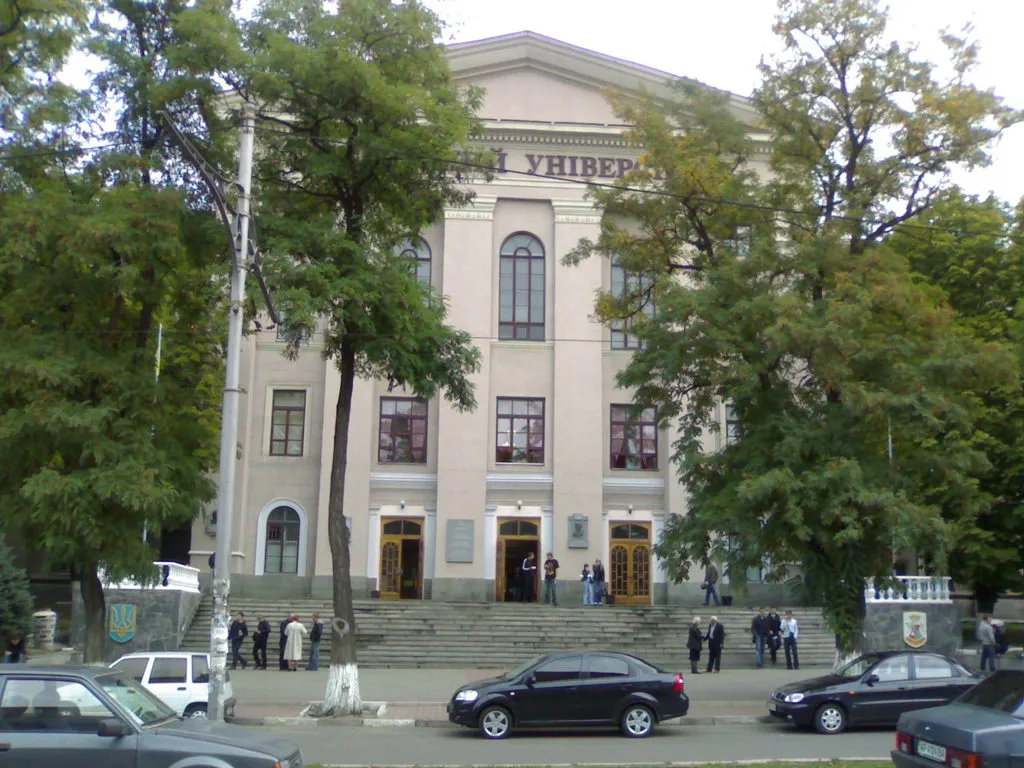
In 2002, five institutes were organized within the university in order to further increase the efficiency of management: mechanical engineering, physical and technical, informatics and radioelectronics, economic and humanitarian, continuous education. In 2007, another Institute of Management and Law with three faculties and eight departments was created as part of the university.
A strategic direction of the university’s activity has become the opening of new specialties: the reception of applicants for 22 new specialties has been prepared and opened. With the completion of the celebrations on the occasion of the 100th anniversary and the granting of national status, the work on improving the appearance of the university did not stop. During the dedication to the students on September 1, 2003, near the entrance to the main building, a monument to the first director of Oleksandriv Mechanical and Technical School D. Podderyogin, a man with the high rank of Engineer, was unveiled. And before the next birthday of the university, in 2003, near the automobile building, the Alley of graduates of the transport faculty of ZNTU was laid. Before the celebration, the academic council of the university approved the badge «For impeccable work» – the highest award of ZNTU. According to the regulation, it is used to honor university veterans who have worked conscientiously and flawlessly: 45 years — 1st degree, 35 years — 2nd degree, 25 years — 3rd degree.
In 2004, Zaporizhzhia Electrotechnical College and Zaporizhzhia Radio Electronics College became part of the university, and in 2005–2007: Azov Regional Institute of Management, Berdyansk Mechanical Engineering College, Zaporizhzhia Humanitarian College.
He took care of the university and career guidance work. In the conditions of a competitive educational environment, it is one of the leading ones. For several years in a row, the university holds an Open House Day in April, where you can observe a trend towards an annual increase in the number of participants of such an event. During 2004–2005, more than 3,000 future applicants participated in these events: they visited the assembly hall and classrooms for meetings with vice-chancellors, directors of institutes, and deans of faculties, got acquainted with the educational and technical base of specialized departments, and learned about the areas of specialist training, admission and study conditions. Each potential applicant received informational materials: booklets about the faculties with information on the areas of specialist training and the newspaper «Engineering Engineer», issued specially for the Open Doors Day.
The university participated in all events that disseminated information about the educational institution in the country and beyond. The university’s participation in the annual international exhibition of educational institutions «Modern Education in Ukraine», organized by the Ministry of Education and Science of Ukraine and the Academy of Pedagogical Sciences of Ukraine, has become traditional. ZNTU took part in it for the first time in 2001. More than 200 institutions of higher education participate in the exhibition at the «Olimpiyskiy» expo center in Kyiv, each of which presents the results of educational, educational and scientific work at its own stand. At each exhibition, the university constantly participates in competitive nominations from separate areas of activity:
- 2001 — the university was awarded a bronze medal in the nomination «Best advertisement of educational institution’s achievements»;
- 2003 — with a bronze medal in the nomination «Computerization and informatization of the educational process»;
- 2004 — with a silver medal in the nomination «Development and implementation of a distance learning system»;
- 2005 — with a gold medal in the nomination «Creation of a system of training graduates of higher educational institutions for competitive conditions of the labor market»;
- 2006 — with a silver medal in the nomination «Introduction of new forms of organization of the educational process»;
- 2007 — with a gold medal in the nomination «Integration of science and education in a higher primary school»;
- 2008 — with a gold medal in the nomination «Creation and production of innovative teaching aids»;
- 2009 — with a gold medal in the nomination «Integration of science and education — a necessary condition for improving the training of specialists in higher educational institutions»;
- 2010 — ZNTU was awarded the Laureate Diploma of the public action «Flagships of Education and Science of Ukraine» and the Grand Prix Diploma «Leader of Higher Education of Ukraine» for a significant contribution to the scientific and educational spheres of state building, to the development of the image of education and science of Ukraine.
During 2010–2015, work continued on opening new specialties. Thus, the training of specialists in 16 specialties has been started: «Industrial and civil construction», «Artificial intelligence systems», «Software engineering», «Composite and powder materials, coatings», «Thermal treatment of metals», «Intelligent technologies of microsystem radio electronic equipment», «Industrial and civil construction», «Marketing», «Finance and credit (according to specialized programs)», «Information technologies of design». «Transport systems (by types of transport)», «Organization and regulation of road pyxy», «Electromechanical equipment of energy-intensive industries», «Quality, standardization and certification», «Project management», «Social institution management».
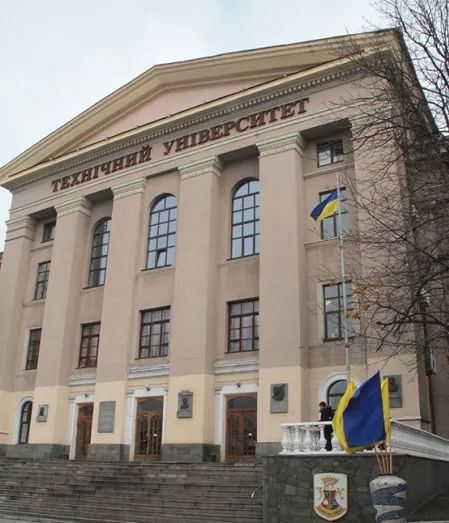
New educational programs were introduced at the university, training of OKR specialists «Bachelor», «Specialist», «Master» was started. Specialists of the «Bachelor» OKR were trained in 36 specialties, the «Specialist» OKR – in 53 specialties with a total licensed volume of 2,875 people, the «Master» OKR – in 50 specialties. All specialties were certified. From 1998 to 2015, the number of certified specialties increased from 23 to 53, and the number of licensed persons increased from 1,125 to 2,875.
In 2014, ZNTU prepared information on qualifications, content and results of studies, academic and professional rights, the system of higher education in all areas of training and specialties of the «Specialist» and «Master» vocational training courses. The diploma supplement corresponds to the model developed by the European Commission, the Council of Europe and UNESCO/CEPES. According to the results of the work carried out, 126 graduates (62 bachelors, 47 specialists, 17 masters) of ZNTU immediately received supplements to the diploma of the European model.
In order to establish a uniform procedure for organizing academic mobility programs for participants in the educational process of higher education institutions of Ukraine on the territory of Ukraine or outside of Ukraine, the Regulations on the Procedure for the Implementation of the Right to Academic Mobility of Participants in the Educational Process of ZNTU were developed. In accordance with modern trends in the informatization of the educational process in the European educational space, in connection with the use of ECTS, information packages have been released for each field (specialty) as guides for students (students) and teaching staff and potential partners, the purpose of which is to promote the transparency of the educational and professional program, orient students (students) to the choice of appropriate specialist training programs and plan further studies, including in other higher education institutions. Information packages of ZNTU have become guides for employers, applicants, students (students), scientific and pedagogical workers, and other interested parties. In 2018, Recommendations on educational and methodological support of educational disciplines at ZNTU, Regulations on the rating system for evaluating the activities of scientific and pedagogical workers, departments and faculties of the Zaporizhzhia National Technical University (with changes), Regulations on professional development and internships of pedagogical and scientific and pedagogical workers at the Zaporizhzhia National Technical University were developed.
Scientific and scientific and technical activities at the university during 2010–2014 were carried out according to three thematic plans: scientific and research works, which were carried out at the expense of the general fund of the state budget (fundamental and applied) on the order of the Ministry of Education and Science of Ukraine; research works, which were carried out at the expense of a special fund of the state budget on the order of enterprises and organizations of the Zaporizhzhia region; departmental research works according to individual plans of teachers.
All types of research work are coordinated by the research department of the university. In its composition, it has leading scientific schools, scientific research laboratories, temporary scientific research groups, departmental scientific teams. Full-time researchers of the research department, scientific and pedagogical workers of the university, doctoral students, graduate students, and students took part in research and development. The main contribution to the implementation of the NDR is made by the employees of eight scientific schools of the university:
- «Foundry production» (1946, founder — Doctor of Technical Sciences, Prof. Yu. A. Shulte, scientific supervisor — Doctor of Technical Sciences, Prof. V. V. Lunyov, Honored Worker of Science and Technology of Ukraine). The main area of activity is the study of the influence of non-metallic inclusions on the physical and mechanical properties of steels and alloys, in particular: improvement of technologies for obtaining castings of heat-resistant alloys by the method of directional crystallization for parts of aviation equipment; application of rare earth and alkaline earth elements in the production of foundry alloys for the mining and metallurgical and mining industry and other branches of technology; improvement of production technologies of iron castings. During 2014, three NDRs were performed, of which two were contractual and one was cathedral;
- «Materials Science and Heat Treatment» (1945, founder — Doctor of Technical Sciences, Prof., Honored Worker of the Higher School of Ukraine B. S. Natapov, scientific director from 1983 to 2012 — Doctor of Technical Sciences, Professor, Honored Worker of Science and Technology of Ukraine, Academician of AINU A.D. Koval, then scientific director — Dr. Tech. Sciences, Prof. S. B. Belikov). The main directions of scientific activity are: the theory of anomalous steel, the principles of this theory at one time made it possible to improve the stampability during deep drawing of auto sheet; development of scientific principles of alloying and heat treatment of heat-resistant alloys resistant to high-temperature corrosion in gas turbine fuel combustion products with corrosion-active impurities (sulfur, sodium, potassium, sea water, etc.);
- «Materials Science in Mechanical Engineering» (1972, founder and director — Doctor of Technical Sciences, Prof. I. P. Bolchok). The main direction of scientific activity is the study of the mechanisms of destruction of structural materials and the creation of alloys for work under conditions of mechanical and thermocyclic loads, low and high temperatures, abrasive wear and chemically active environments. In recent years, considerable attention has been paid to the development of the chemical composition and production technology of economically alloyed graphitized steels with the aim of replacing medium and high-alloyed steels, as well as the development and implementation of processes for the production of high-quality aluminum alloys from cheap secondary raw materials;
- «Radio engineering and information technologies» (1998, founder and director — Doctor of Technical Sciences, Prof. D.M. Pisa). The main directions of scientific activity are the development and creation of: interference-resistant radio technical systems; plant object recognition devices; automated control systems.;
- «Mechanics of a deformable solid body with geometric and physical features» (1967, founder – Doctor of Technical Sciences, Prof., Honored Worker of Science and Technology of Ukraine A. Sh. Asaturyan, Director – Head of the Department of Applied Mathematics, Candidate of Technical Sciences, Associate Professor Yu. V. Mastynovskyi). The main direction of scientific activity is the development of mathematical models and methods for solving problems of the mechanics of a deformable solid body with geometric and physical features. 4 professional articles and 14 report abstracts were published. The total number of publications was 23;
- «Processing of materials by cutting in mechanical engineering» (1986, scientific supervisor — Doctor of Technical Sciences, Prof. Yu. M. Bnukov). The main directions of scientific activity: integrated technologies for improving the efficiency of cutting tools; modern polymer-abrasive tools and the expansion of the fields of their introduction into production; improving the quality of the treated surface during various methods of processing materials by cutting (turning, milling) by reducing vibrations;
- «Nano-sized systems and devices» (2001, founder — Doctor of Physical and Mathematical Sciences, Prof. V. V. Pogosov). The main area of activity is the research of electronic and positron charge and size effects in nanostructures and clusters, one-electron effects in tunnel structures, in particular: creation of the theory of infrared absorption of metal nanocomposites and the conductivity tensor of metal nanoparticles, films and wires; development of analytical and numerical approaches to the decay of quasi-stationary states in open quantum dots and, accordingly, the tunnel current theory for single-electron devices; modification of the density functional method and creation of codes for self-consistent calculations of electron and positron output (as well as their annihilation characteristics) for metal-dielectric nanosandwiches; experimental study by the Kelvin method of the regularities of changes in the output work (Volts of the surface potential) of thin metal films depending on their thickness and electrical conductivity under the action of active hydrogen particles;
- «Electrical and electronic devices» (2010, founder and scientific leader – Doctor of Technical Sciences, professor, Honored Inventor of Ukraine, Academician of the Transport Academy of Ukraine P.D. Andriyenko).
Main areas of work: research of electromagnetic processes in semiconductor devices for electric drives and energy-intensive industries; diagnostics of high-voltage electrical devices. One of the important indicators of the university’s scientific achievements is the number of scientific works published by the university’s scientists. The latest results of scientific research are highlighted in monographs, textbooks, scientific articles published in Ukraine and abroad. The total number of such publications tends to increase annually. In 2014, university scientists published 9 monographs, 20 educational manuals, and 4 textbooks. Monographs, textbooks and study aids published by university scientists are used both by students of ZNTU and other institutions of higher education in Ukraine. 607 articles were published in scientific journals, including 73 in foreign journals). In addition, 1222 scientific articles were written, published in collections of scientific works and collections of articles, abstracts of conferences. In general, in 2014, university employees published 2,013 printed works. The presence in the university of its own publications, which have the status of professional according to the list of the State Academic Council of Ukraine, greatly contributes to the preparation and timely defense of candidate and doctoral theses. These are the following magazines: «New materials and technologies in metallurgy and mechanical engineering», «Radioelectronics. Informatics. Management», «Electrical Engineering and Power Engineering», «Engineering Bulletin» (co-founders – PJSC «Motor Sich» and NAU «KHAI»).
During the decade, on a systematic basis, positive results were continued and achieved in the establishment and development of the university’s international relations. ZNTU has more than 60 valid agreements with universities and educational organizations of many countries. The effectiveness of the university’s participation in the implementation of the EU-funded «TEMPUS» programs has significantly increased, sports and mass work has achieved significant development. ZNTU handball and basketball teams play in the Super Leagues of Ukraine, the national aerobics team is the winner of all-Ukrainian and international competitions, including victories at European and world championships.
In recent years, Zaporizhzhia Polytechnic National University has become the organizer and co-organizer of many scientific and technical events (scientific and practical conferences, scientific seminars. Within the framework of these events, the patent and information department, in cooperation with university departments, held 9 exhibitions, 5 of which are international. The university also took part in 6 international scientific and scientific and practical exhibitions.
Scientific research and innovative work of students is an effective method of training qualitatively new specialists in higher education. In 2019, more than 100 student scientific circles, problem groups, and preparation groups for the All-Ukrainian student Olympiads and competitions functioned at the university. 2,643 students (33.42% of the total number of students) are covered by various forms of NDRS. An important factor in the high level of preparation is the participation of students in the All-Ukrainian competition of student scientific works. During January-February 2019, 112 student research papers were sent to basic institutions of higher education for the II stage of the All-Ukrainian competition. The constant growth of the scientific potential of Zaporizhzhia Polytechnic National University is definitely proven by the number of winners of the competition this year. 31 students received the diploma of the winner of the All-Ukrainian competition of student scientific works in various fields.
According to the order of the Ministry of Education and Science of Ukraine, Zaporizhzhia Polytechnic National University was designated as the base institution of higher education for conducting the All-Ukrainian Student Olympiad in the specialty «Electrotechnical Systems of Power Consumption». Teachers and employees of the Department of Power Supply of Industrial Enterprises diligently and conscientiously prepared for this event, which took place at the end of April 2019. 70 students and teachers from 24 universities of Ukraine came to the university to compete. Traditionally, the annual scientific and practical conference of teachers, scientists, young scientists, graduate students and students of Zaporizhzhia Polytechnic National University «Science Week» was held from April 16 to 20 at all departments.
The intensity of the students’ scientific work is also evidenced by the large number of student publications – in 2019, 1,451 articles were published with the participation of students, of which 242 were published independently.
In October 2019, three students who were trained at the departments of computer systems and networks, tourism, hotel and restaurant business, international tourism, management of physical culture and sports became laureates at the competition of gifted youth, introduced by the Zaporizhzhia Regional State Administration.
Every year, with the aim of encouraging capable students to research, 120 scholarships of the Zaporizhzhia city mayor are awarded in the nomination «For success in scientific work and successful studies». The winners of the All-Ukrainian Olympiads and competitions and their academic supervisors, according to the rector’s orders (on the basis of the orders of the Ministry of Education and Culture of Ukraine), are awarded cash prizes.
In recent years, a system of cooperation between the university and employers has been introduced, in particular, the University’s Employment Assistance Center with the Zaporizhzhia Union of Entrepreneurs and Industrialists (Employers) «Potential». Fruitful cooperation was established with the Dnipropetrovsk Center for Independent Assessment of the Quality of Education, and the Center for Independent Testing was operating at Zaporizhzhia Polytechnic University.
On a systemic basis, positive results were achieved in the work on establishing and developing the university’s international relations. In 2019, the main educational center of ZNTU-«Delcam» University (Birmingham, Great Britain) successfully coordinated the project «Advanced computer technologies – for universities of Ukraine». An agreement was signed with the company «AUTODESK» regarding the further support of the program.
Since 2008, the university has operated a regional branch of the Black Sea Universities Network (BSUN). Over the years, the number of higher education institutions of Ukraine that are BSUN members has reached 29, which is the largest among the participating countries.
The efficiency of Zaporizhzhia Polytechnic University’s participation in the implementation of the EU-funded «ERASMUS+» program has significantly increased, sports and mass work has achieved significant development. The university handball team became the bronze medalist of the Super League of Ukraine, the team in aerobics became the winners of all-Ukrainian and international competitions, the Universiade became the bronze medalist of the European Championship. Five students of Zaporizhzhia Polytechnic National University participated in the World Universiade (Naples, Italy), two became prizewinners of the games.
Great attention was paid to the development of student self-government. Student self-government bodies were formed, members of the academic council and labor collective conference were elected from students by direct secret ballot.
The rector of the university, as a deputy of the Zaporizhzhia Regional Council, worked as part of the humanitarian affairs commission (deputy chairman). At the expense of the deputy fund, two points of weather-dependent automation were created in dormitories No. 3 and No. 4.
The achievements of the highly qualified staff of the higher education institution are significant – in the 2019 TOP-200 Ukraine HEI rating, ZNTU took 48th place (first among HEIs of the Zaporizhzhia region), in the rating according to the data of the scientometric database «Scopus» – 47th place (first among HEIs of the Zaporizhzhia region), in the consolidated rating of 2019 – 64th place.
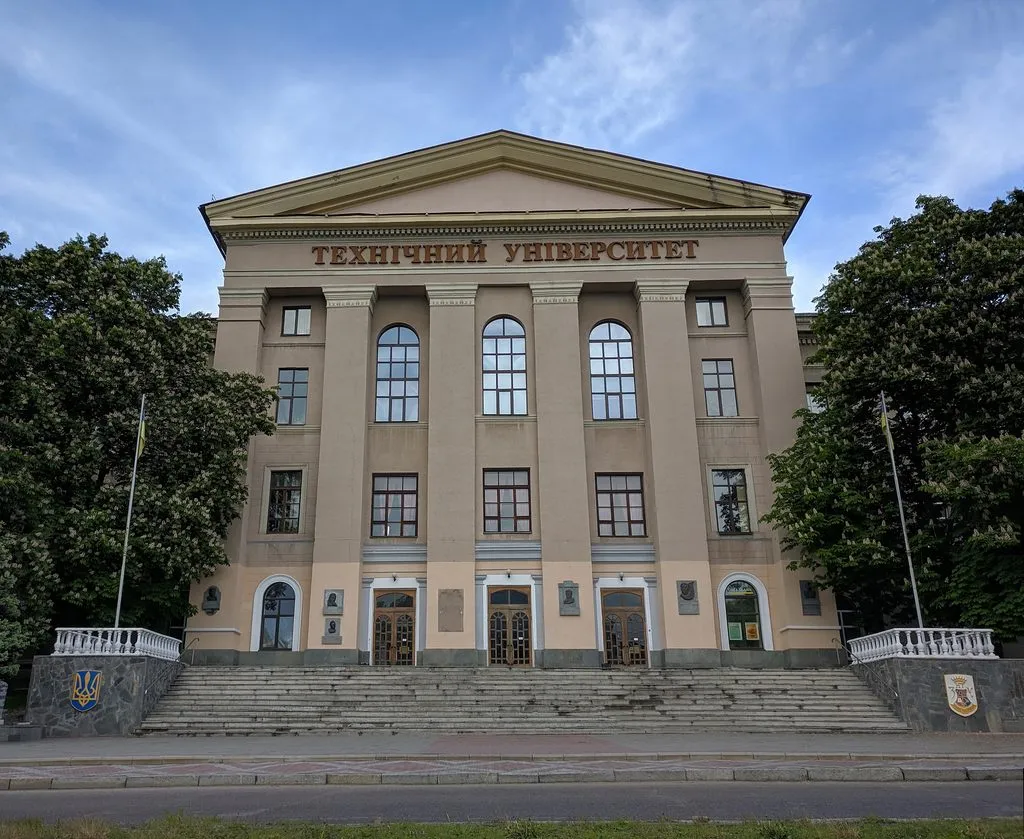
ZNTU consisted of 5 institutes, 13 faculties, 60 departments, 9 educational and laboratory buildings, had 4 student dormitories for 2,300 places, a library with a book collection of over a million copies, an editorial and publishing department, a computer printing press, two sports and health camps, a medical center, a sports complex, an administrative and economic part.
13,000 students studied at the university, and there was a military department for the training of reserve officers.
The teaching staff numbered approximately 800 people, of whom more than 550 have scientific degrees and scientific titles, including 81 doctors of science, professors, 24 teachers elected as full members and corresponding members of branch academies of Ukraine, 25 awarded the honorary titles «Honored Worker of Science and Technology of Ukraine», «Honored Worker of Education of Ukraine», are laureates of the State Prize of Ukraine in the field of science and technology, awarded with orders of Ukraine.
Tens of thousands of young people leave the walls of the Zaporizhzhia Polytechnic not only as excellent specialists, but also as people with an active life position and solid spiritual baggage.
Among the graduates of the «machine» – ZNTU-NU «Zaporizhzhia Polytechnic» there are many people’s deputies, representatives of state authorities, managers of large enterprises, business structures, figures of science and education, culture and sports.
Achievements of Zaporizhzhia Polytechnic University have earned a well-deserved reputation both in Ukraine and abroad. This is evidenced by numerous honorary titles, prizes, awards of its scientists and graduates, fruitful international cooperation with institutions of higher education and scientific institutions of countries of all continents of the world.
About the Museum of the History of Technical Progress
The opening of the Museum of the History of Technical Progress took place within the framework of the celebration of the 116th anniversary of technical education in Zaporizhzhia (Aleksandrivsk) Region and International Students’ Day. The idea of creating a museum belongs to the rector of ZNTU S.B. Belikova, which was implemented in 2016. Education of students through museum means permeates all spheres of their activity: educational, scientific, leisure and promotes the activation of students’ creative activity by involving them in research and local history work. Museum exhibits form in the minds of young people a real idea about the figures of the past, help to master the skills of future professions. The specificity of museums of higher educational institutions differs from others in that the museums of higher education institutions store invaluable information – its DNA, without exaggeration. Today, the museum is perceived as an institution of public influence and image.
Zaporizhzhia is the industrial capital of Ukraine with great scientific and technical potential. It was here in the second half of the 19th century that the rapid growth of industry began, which contributed to the development of science and education. In 1900, the first secondary school in Ukraine was opened in the city of Oleksandrivsk (Zaporizhzhia) – a seven-grade mechanical and technical school. Founded 119 years ago, our university, along with the Lviv and Kharkiv Polytechnics, stood at the sources of formation of domestic engineering personnel. A huge role was assigned to the formation of talented, educated individuals who, having created their scientific schools, made a significant contribution to science, accelerated the development of industry and initiated new fields of knowledge, which determined the scientific and technical rise of the 20th century. This should be known, remembered and passed on to the younger generation. The main focus of the museum’s research is the disclosure of the greatest achievements of our country in engineering and technology, the interconnection of various branch knowledge, and the search for new paths in science.
The mission of the university museum traditionally consists in ensuring a high level of educational and scientific activity of a higher educational institution, forming a scientific worldview. The expositions of the museum take into account chronological and thematic principles, emphasize the inextricable connection between the history of the university and the history of the city of Zaporizhzhia.
Museum funds and expositions contain monuments of the history of the city of Zaporizhzhia: photographs, books, certificates, certificates, unique exhibits from the construction period of Dniproges, personal belongings of students and teachers, the first car ZAZ-965-A, which was a gift from the family of S.I. Tailor
Today the museum has 40 stands and over 200 exhibits. Expositions are presented in thematic blocks: – the industry of Oleksandrivnsk at the beginning of the 20th century; – education of the county city of Oleksandrivska; – mechanical and technical school. Organization of the educational process; – periods of life: from mechanical and technical school to Zaporizhzhia National Technical University; – scientific schools. A separate stand is occupied by awards and honors of the university’s activities in recent years. The materials of the author’s collective of the historical essay «Zaporizhzhia National Technical University» edited by O.F. Bichevy and M.V. Dedkova Help was provided by Zaporizhzhia factory museums, the Dniprohesi Museum, the Regional Museum of Local Lore, the Zaporizhzhia Regional Center for Scientific and Technical Creativity of School Students «Grania», teachers V.V. Lunyov, O.P. Sarnatskyi, E.I. Ivakhnenko, V.I. Shurlo, Gordeeva P.S., Prushkivska E.V. S. I. Atamanyuk, great-grandson of Oleksandrivska brick plant manager O. Minaev and others.
The main financial assistance was provided by the ZDTU Development Promotion Fund «ZDTU-ZMI named after V.Ya. Chubarya: a view in the 21st century». Patrons of the creation of the museum were the enterprises of the city, the heads of which are graduates of «machines» OJSC «Motor Sich» (Boguslaev V.O.), «Iskra» (Presnyak I.S.), deputies of the Verkhovna Rada of Ukraine O.V. Romanovskyi, O.I. Dudka, Honorary Citizen of Zaporizhzhia Kartashov E.G., deputy of the regional council S.V. Grachov, director of the Ukrmontazhkhimzakhist LLC trust Kovylin A.A., dean of the transport faculty Kuzkin O.F., head of the department of equipment and technology of welding production Ovchinnikov O.V.
This year, in November, the museum turns three years old. It should be noted that they were full of interesting meetings and exciting new work. Since the beginning of the foundation of the museum, the number of visitors has amounted to almost 6.5 thousand people – this is a good indicator. Among the visitors are students of our university, as well as guests – representatives of foreign delegations, students of schools in Zaporizhzhia and other cities of the region, representatives of the Ministry of Education and Science of Ukraine, the Ministry of Justice of Ukraine, guests from various universities of Zaporizhzhia and Ukraine. The museum was visited by participants of the International scientific and practical conference «Society, religion, culture, science, technology, education and economy in the conditions of the latest global challenges for Ukraine and Poland», representatives of the Technical University (Germany), teachers from Turkey and others. Today, museum tours are conducted in Ukrainian, Russian, Polish and English.
Work continues in the archives on new finds for the museum. Thus, while working in the Zaporizhzhia Regional Archive, an interesting material was discovered about the role of Felix Movchanovsky, the mayor of Oleksandrivka at the beginning of the 20th century, in the creation of a mechanical and technical school. Together with the Boguslaev Museum of Technology, two new stands have been prepared: about the first director of the Motor Sich plant – Syromyatnikov and the army general, a graduate of our mechanical and technical school – V. Sudets.
The educational activity of the museum consists in expanding and deepening general education, technical professional training of young people, providing assistance to students and teachers in writing scientific and creative works. For first-year students, sightseeing tours of the history of the university are held. In order to popularize the university, the museum is visited by students of ZNTU colleges, schools of Zaporizhzhia and the region, pupils of the Zaporizhzhia Regional Center for Scientific and Technical Creativity of Student Youth «Grania», the Creativity Center «Polyt» of the Zaporizhzhia City Council, the station of young technicians of the city of Zaporizhzhia, the Zaporizhzhia Vocational Lyceum of Water Transport and others.
The museum is constantly updated and enriched with new interesting exhibits. The transition to a post-industrial society, restructuring of the economy leads to the destruction of samples of equipment of entire plants and factories. Tomorrow they may not be, tomorrow everything will go to scrap metal. Preserving these specimens for future generations is one of the museum’s tasks. The history of science and technology is part of the nation’s spiritual potential. Comprehensive progressive development of the nation cannot do without parts of historical knowledge, which, in particular, museums of a technical profile can convey.
Activities of Zaporizhzhia Polytechnic National University (2019–2025): key historical events, institutional transformations and achievements
According to the Order of the Ministry of Education and Science of Ukraine No. 420 dated April 1, 2019, the Zaporizhzhia National Technical University was renamed Zaporizhzhia Polytechnic National University. On June 25, 2019, a new edition of the Statute of Zaporizhzhia Polytechnic University was approved.
The period from 2019 is marked by the further strengthening of the university’s position as a leading technical institution in Ukraine. Changing the name to Zaporizhzhia Polytechnic National University was a logical step, reflecting multidisciplinary, innovative and compliance with international standards. The university continues to actively modernize educational programs, introducing new specialties that meet the needs of the modern labor market, in particular, in the field of information technologies, cyber security, and alternative energy.
Special attention is paid to digitalization of the educational process. The university actively uses modern online platforms for learning, which allows students to access knowledge at any time and from anywhere in the world. This has become especially relevant in connection with the COVID-19 pandemic and the full-scale war that began in 2022.
In 2022, candidate of technical sciences, professor Greshta Viktor Leonidovych was elected rector.
With the beginning of Russia’s full-scale invasion of Ukraine, the university, like the entire country, faced unprecedented challenges. However, the university team, despite the shelling and proximity to the front line, showed incredible resilience. The educational process was quickly adapted to the conditions of the martial law, transferred to a distance format, which made it possible to preserve the educational process and support students, many of whom were forced to leave their homes.
In these difficult years, the university not only continues its educational activities, but also provides significant support to the Armed Forces of Ukraine. Teachers and students develop and manufacture equipment for military needs, participate in volunteer initiatives. This activity became part of the university’s new mission — not only to train specialists, but also to contribute to the protection and restoration of the country.
During 2019–2025, Zaporizhzhia Polytechnic National University demonstrated active adaptation of educational programs to the needs of the labor market and dynamic changes in society. An analysis of the admission rules and the list of programs for 2020 and 2021 shows that the University offered a wide range of specialties in key areas of knowledge. This covered in-demand fields such as Software Engineering, Computer Science, Cyber Security and Systems Analysis in the field of Information Technology. In addition, the University supported the traditional for the industrial region specialties in the field of «Mechanical Engineering», offering programs from «Mechanical Engineering Technology» to «Aviation Engines».
One of the most interesting and strategically important programs was «Flight operation of aircraft» in the field of «Transport». This educational program, which trains civil aviation pilots, directly responds to the projected global shortage of personnel. According to data from the International Civil Aviation Organization (ICAO) and the Boeing Corporation, the global demand for new pilots and technicians in the next 20 years (from 2021 to 2041) will amount to hundreds of thousands of specialists. The initiation and development of such a program demonstrates that the University not only preserved its traditional strengths, but also systematically responded to global trends and trained personnel for high-tech industries that will determine economic development in the future.
This transition was not just a spontaneous reaction, but a planned adaptation. The presence of the «Freshman’s Guide», which helped new students to navigate, as well as the active use of the Moodle distance learning system indicate that the University had an institutional readiness to work in crisis conditions. Such measures made it possible to support the educational process in its entirety, which indicates flexibility and the ability for strategic planning, which is critically important for preserving the functionality of the institution in the face of a direct threat.
Admission campaigns during the reporting period took place in accordance with the rules, which were annually approved by the academic council of the University and published on the official website. Clear norms were established regarding the number of applications that an applicant could submit: up to five applications for state procurement positions and up to fifteen applications in total for all funding sources. The application process has been completely transferred to electronic form. In 2020, entrants to the degree of Doctor of Philosophy could finance their studies both from the state budget and under the terms of a contract, including funds from grants for scientific research.
Organization and coordination of scientific and scientific and technical activities at Zaporizhzhia Polytechnic National University is carried out by the Scientific and Research Department, which is a structural division of the University. It includes key administrative and management departments, in particular the Scientific and Technical Department, the Patent and Information Department and the Department of Metrology, Standardization and Scientific Equipment. The main priority directions of scientific research, on which the scientific schools of the University worked, were information and communication technologies, including the development of information and diagnostic systems and methods of processing big data, as well as research in the field of energy. These directions emphasize the engineering and technical specialization of the institution and its focus on solving current problems that meet the needs of the modern economy.
During the reporting period, the University significantly expanded its innovation infrastructure, creating a number of hubs that contributed to cooperation with business and regional development. These include European Digital Innovation Hub, Energy Innovation Hub and Regional Innovation Hub of Zaporizhzhia National University polytechnic”.
The Regional Innovation Hub, created on February 25, 2025, is of particular importance. Its main goal is to support inventions, innovations and start-up projects in the region. The functions of the hub include: creating a platform for collaboration between business and students for the development of research and education; stimulation of startups through incubation programs, competitions and cooperation with venture capital funds; personnel training through practice-oriented educational programs and internships; promoting technological transformation and digitization, in particular, through the introduction of Industry 4.0 tools.
Creation of the hub in 2025 is a clear signal of the strategic vision of the University’s leadership aimed at post-war reconstruction and integration into the new economy. This positions the institution not just as an educational center, but as a key element of the economic recovery of the Zaporizhzhia region.
In addition, Noosphere Engineering School functions as an effective startup platform, providing students and young scientists with free technological and marketing support, as well as mentoring. Examples of selected projects, such as the development of a PEEK 3D printer and living indoor filters, highlight the practical orientation of the University and its ability to transform scientific ideas into innovative products.
Scientists of the University, despite military challenges, demonstrated high scientific productivity. This fact is confirmed by continuous publishing activity in prestigious international scientometric databases, in particular Scopus and Web of Science. As an example, in July 2023 alone, in the midst of a full-scale invasion, a number of scholarly works were published in fields such as mathematical sciences, economics, management, materials science, and finance. The fact of the continuation of scientific activity in such conditions is a strong proof of the stability and dedication of the scientific community of the University to its work.
Reporting to the Ministry of Education and Science of Ukraine did not stop either. Every year, the University submitted detailed reports, which included information on the implementation of scientific research and development, indicators of innovative activity and implementation of budget programs. This reporting confirms the high level of institutional management even in the most difficult periods.
The department of international activities and work with foreign students is responsible for international cooperation at the University. Its main goal is the organization and development of cooperation with foreign educational institutions, scientific institutions, organizations and firms in the fields of education, science and culture. The functions of the department include finding partners, concluding agreements, disseminating information about international grants and scholarships, as well as assisting students and employees in participating in international programs.
In the period 2019–2025, the University continued to actively participate in international projects, which is evidence of a high level of trust from foreign partners. Among the key projects in which the institution participated:
- «Innovative Multidisciplinary Study Program for Bachelors and Masters in Artificial Implants for Bioengineering» (BIOART): The project was completed in 2020.
- Cross-domain competences for healthy and safe work in the 21st century (WORK4CE): Implemented from 2020 to 2023, demonstrating continued international cooperation even after 24 February 2022.
- USAID project «Cyber security of critical infrastructure of Ukraine»: The activity of this project in 2020-2024 indicates the strategic importance of the University for national security and its role in training specialists in a critically important field. This collaboration underscores that, despite military action, the University continues to be seen as a reliable and effective partner in an industry critical to the country’s defense capability.
The international activity of Zaporizhzhia Polytechnic National University (Zaporizka Polytechnic University) covers several main areas: training of specialists for foreign countries, participation in international competitions for obtaining grants, exchange of scientific and methodological developments and cooperation with foreign institutions of higher education (HEIs). Over the years of its existence, the university has trained more than 1,500 specialists-citizens of the countries of Asia, Africa, Europe, and Latin America. Business, scientific, educational and cultural ties with educational institutions in China, Germany, Poland, Russia, France, etc. are supported.
In 2024, scientists, teachers and students of the university actively participated in international programs. In particular, 58 teachers took part in foreign trainings, internships and conferences. At the same time, 76 students and postgraduates became participants in online and offline academic mobility programs. In general, more than 130 people took advantage of such opportunities.
Zaporizhzhia Polytechnic University is an active participant in numerous international educational programs, including Global UGRAD, DAAD, Fulbright and Erasmus+. As part of the Erasmus+ program (KA1) in 2024, 4 students and 2 teachers participated in academic mobility, who studied and gave lectures in European higher education institutions. The University also participated in the implementation of 2 projects under the Erasmus+ program (KA2).The key international projects of 2024 include:
- Erasmus+ WORK4CE: The project aimed to develop a new form of cooperation between universities and enterprises to improve the employability of graduates in the age of digital technologies. Within its framework, open educational resources and competence models for «Industry 4.0» were created.
- DAAD ViMaCs and EuroPIM: These projects were aimed at creating a virtual educational infrastructure, digitizing educational spaces and providing distance courses to improve teaching skills. More than 150 students participated in the DAAD «Ukraine digital» program, and 30 of them received monthly scholarships.
- Joining program with Cardiff University: Thanks to this program, in 2024 Zaporizhzhia Polytechnic teachers and students improved their English language skills, and scientists conducted joint research in the field of materials science (for example, the study of titanium and magnesium alloys) and aeronautical engineering.
The University supports 62 current agreements with educational institutions and enterprises from various countries, including Azerbaijan, Belgium, Germany, Poland and Spain. In 2024, 16 new agreements were signed, including with the University of Stuttgart, the Krakow University of Technology and the University of Silesia in Katowice.
Participation in international projects and programs allows the University to follow current world trends, improve educational practices and integrate into the European scientific space.
The financial position of the University demonstrates the stability that allowed it to function in crisis conditions. According to the financial report for 2024, the total amount of income was UAH 528,101.0 thousand. This amount consisted of UAH 331,912.5 thousand of revenues from the general fund of the state budget and UAH 196,188.5 thousand from the special fund. This funding structure, relying on both government support and own revenues (perhaps from foreign projects, grants, or contract training), made it possible to compensate for potential losses caused by the war. This financial stability emphasizes the key role of state support and international cooperation in ensuring the institution’s viability in a critical period.
During 2019–2025, the University acted not only as an educational, but also as an organizational and leadership center for the educational community of Ukraine. Of particular importance was the holding of the All-Ukrainian Forum «Educational Leadership Days 2024», held on June 6-7 at the University in Zaporizhzhia. The event became a platform for discussing the future of Ukrainian education, its integration into the European space and the formation of strategies for the development of higher education in the conditions of war. The participation of high-ranking leaders, in particular the Deputy Minister of Education and Science of Ukraine and the Chairman of the Committee of the Verkhovna Rada of Ukraine on Education, testifies to the high authority of NU «Zaporizka Polytechnic» at the national level, even in conditions when the city was under constant threat. Holding such a large-scale event is a powerful symbolic act that demonstrates the steadfastness of the University as a center of educational leadership. The All-Ukrainian Forum «Educational Leadership Days» on the basis of Zaporizhzhia Polytechnic National University became a traditional event, in 2025 it was held on June 10.
Also, the University organized the forum «Skills of the future. Ukraine», which was held in October 2023 and November 2024. This event, supported by the National Qualifications Agency and the Federation of Metallurgists of Ukraine, demonstrates the University’s strong ties with the state and key industries. Cooperation with such institutions indicates the synergy between education and the real sector of the economy, confirming that the University is a key player in the formation of educational policy that directly affects employment and the economic development of the country.
Among the activities of scientific research work of students, an important place belongs to Olympiads. Yes, in 2019-2020 1635 students from 45 departments took part in the university stage of the student Olympiad. 166 students took part in the II stage of the All-Ukrainian Student Olympiad. In 2019–2020 17 students received winners’ diplomas.
In 2024, Zaporizhzhia Polytechnic students demonstrated high results at regional contest «Student of the Year», winning in four nominations. In addition, they were awarded certificates of honor from the Zaporizhzhia Regional Military Administration. These achievements testify to the high level of preparation and active participation of students in the public life of the region.
Therefore, the period of 2019–2025 became the time of the greatest trials for Zaporizhzhia Polytechnic National University. However, the analysis of the institution’s activities confirms its institutional stability, ability to adapt and strategic vision of the future. During the period 2019–2025, Zaporizhzhia Polytechnic National University not only withstood critical conditions, but also managed to lay the foundation for future development. His leadership position in the organization of national forums and participation in international projects proved that he is a key actor in the processes of restoration and integration of Ukraine into the European educational and innovation space.
In 2025, Zaporizhzhia Polytechnic National University will celebrate its 125th anniversary. This is an anniversary symbolizing the long and glorious journey from a modest mechanical and technical school to a powerful educational and scientific center. During this time, the university survived two world wars, revolutions, and perestroika, but it always remained faithful to its goal — to train highly qualified specialists who are the driving force of development. The future of the university is connected with further integration into the European and global educational space, expansion of international cooperation and development of innovative technologies. The university aspires to become not only a center of education, but also a platform for the development of the latest technologies that will contribute to the restoration and development of Ukraine. Its strength and future development rest on a powerful and reliable foundation laid by decades of fruitful work of many generations of teachers, scientists and students.
Historical materials of this page prepared by Mykola Vasylovych Diedkov – candidate of historical sciences, professor of the department of the Ukrainian State University of Medical Sciences.