Participation of Students from Zaporizhzhia Polytechnic National University in International Academic Mobility

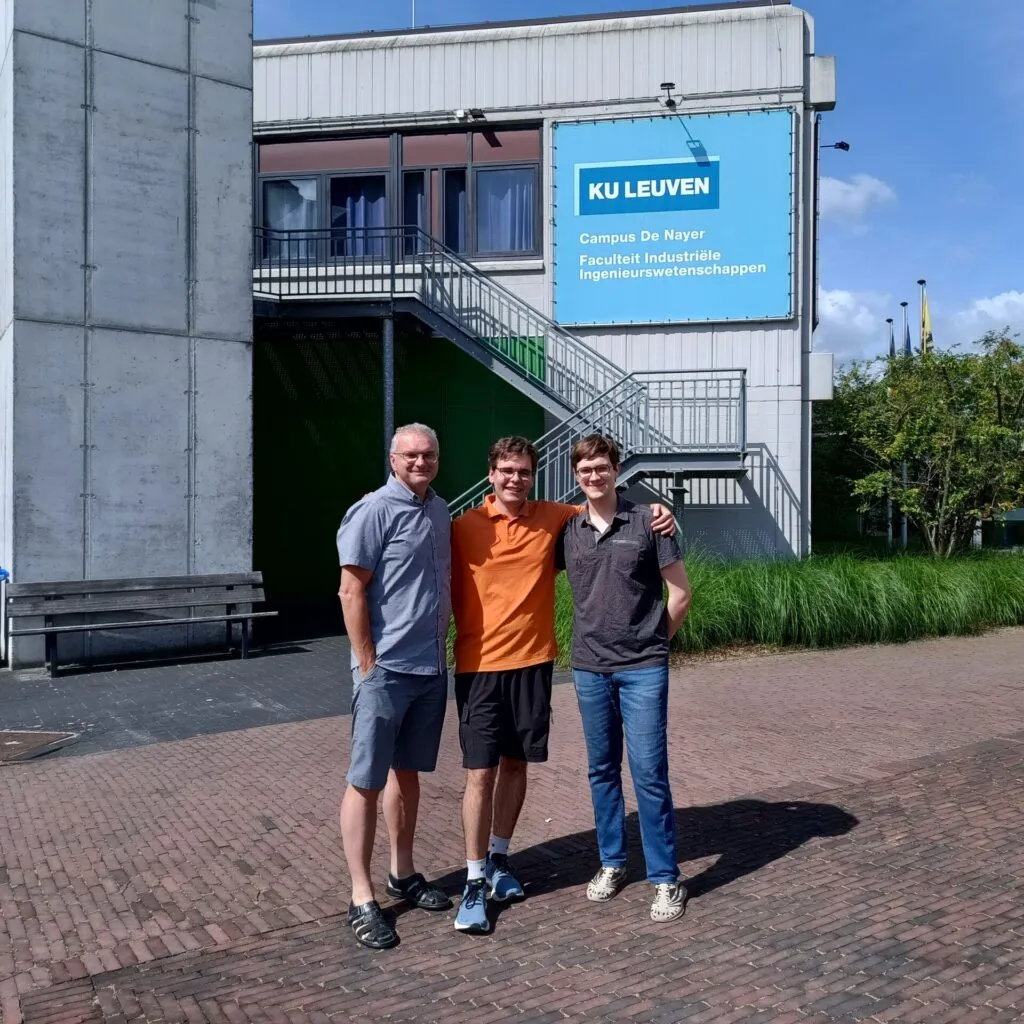
During the spring semester of the 2025–2026 academic year, Zaporizhzhia Polytechnic National University students Dmytro Chernenko (M–614) and Kyrylo Filipenkov (KNT–615m) participated in an academic mobility program at the De Nayer campus of the Catholic University of Leuven in Belgium.
Since 2015, the Catholic University of Leuven and Zaporizhzhia Polytechnic National University have partnered to advance academic mobility.The mutual exchange of students, faculty, and administrative staff was made possible by an inter-institutional agreement between the universities. During this time, 32 students from Zaporizhzhia Polytechnic National University have studied and completed internships at the Catholic University of Leuven.
The academic mobility project coordinator on behalf of the Catholic University of Leuven is Halyna Tabunschyk, a professor in the Department of Software Engineering.
We invite students at Zaporizhzhia Polytechnic National University to participate in international academic mobility programs. Information about current opportunities is available on the university’s website: https://zp.edu.ua/international-activities/academic-mobility/.
We invite you to read Kirill Filipenkov’s reflections on his experience studying at KU Leuven:
Hello! My name is Kirill Filipenkov, and I am a student in the Department of Computer Systems and Networks at Zaporizhzhia Polytechnic National University. I spent the spring semester of 2026 in Belgium, studying through the Erasmus+ academic mobility program at KU Leuven – the country’s oldest university and one of Europe’s leading research universities.
For half a year, my home was the De Nayer campus of the Faculty of Engineering Technologies in the town of Sint-Katelijne-Waver, located between Brussels and Antwerp. I’ll admit: I hesitated for a long time, even after submitting my application – leaving home wasn’t easy, but it was a unique experience.
Belgium is a small country, slightly larger than our Zaporizhzhia Oblast. It has a high standard of living and well-developed infrastructure. I was particularly impressed by the cycling infrastructure. It’s also a wonderful opportunity to immerse yourself in the history of old Europe, as Belgian cities have preserved it at every corner: medieval Bruges and Ghent, the port city of Antwerp, and historic Mechelen right next to the campus. Paris and Amsterdam are just a few hours away by train from here.
Belgians are friendly people who speak English very well, so there’s practically no language barrier in everyday life – at least, I didn’t experience one.
To those who are hesitating, I’ll put it simply: you’re unlikely to be perfectly prepared – just think about whether you’ll have an opportunity like this once you finish your studies. If you occasionally read and watch videos in English – that’s enough; you’ll catch up on the rest once you’re there. You’ll receive support at every stage – both from colleagues at your home university and from the Belgian side.
In 2021, there was a lockdown; in 2022, a full-scale war that continues to this day. During all this time, my colleagues and I attended in-person classes for only 1–2 semesters at best, and even then with interruptions; and, to be honest, I didn’t think it was such a big deal. So, it felt unusual – but very beneficial – to once again experience the need to physically go somewhere on a regular basis and be among other people. And the opportunity to interact directly with the equipment is simply priceless: it’s yet another opportunity we lost due to remote learning.
At KU Leuven, I took four courses: Real-time Embedded Design, Embedded Algorithm Optimization, Information Management, and Student Project. In Real-time Embedded Design, we developed real-time systems – ranging from the theory of task scheduling and real-time operating systems to lab work on actual hardware. The culmination was a project to build an image contour detection pipeline (Gaussian filter + Sobel operator) that runs in real time on an embedded platform.
Embedded Algorithm Optimization course taught me to look at algorithms from a hardware perspective: error theory, computational complexity, and code optimization under strict memory and power consumption constraints. Information Management course covered the design of information systems and working with data.
The topic of my Student Project was optimizing the execution of neural networks on embedded systems. In short: modern image-processing networks “don’t fit” into the memory of small devices, so the order of computations has to be carefully planned. I developed a tool that automatically determines this order and identifies the best trade-offs between on-chip memory capacity and data exchange.
This resulted in a project defense before the research group and a draft of a future scientific article, prepared in collaboration with my advisors.
Finally, I would like to thank the people who made this exchange possible. From my home university—Larisa Mykolayivna Duyko, Galina Volodymyrivna Tabunschyk, Iryna Yakivna Zelenova, Maria Yuriyivna Tyagunova, and the Dean’s Office of the Faculty of Computer Science and Technology – who supported me at every stage, from submitting my application to my return. If this post has inspired you to give it a try, please reach out to them directly. I’d like to express my special gratitude to Peter Arras, who provided support and guidance during my studies at KU Leuven, and to Steven Colleman – my research project advisor.
Erasmus+ isn’t just a “vacation in Europe,” but rather intensive work with elements of travel that pays off in full measure: professional contacts, self-confidence, and a clear understanding of where to grow next.
I wholeheartedly recommend this experience to every student in our department. Good luck!