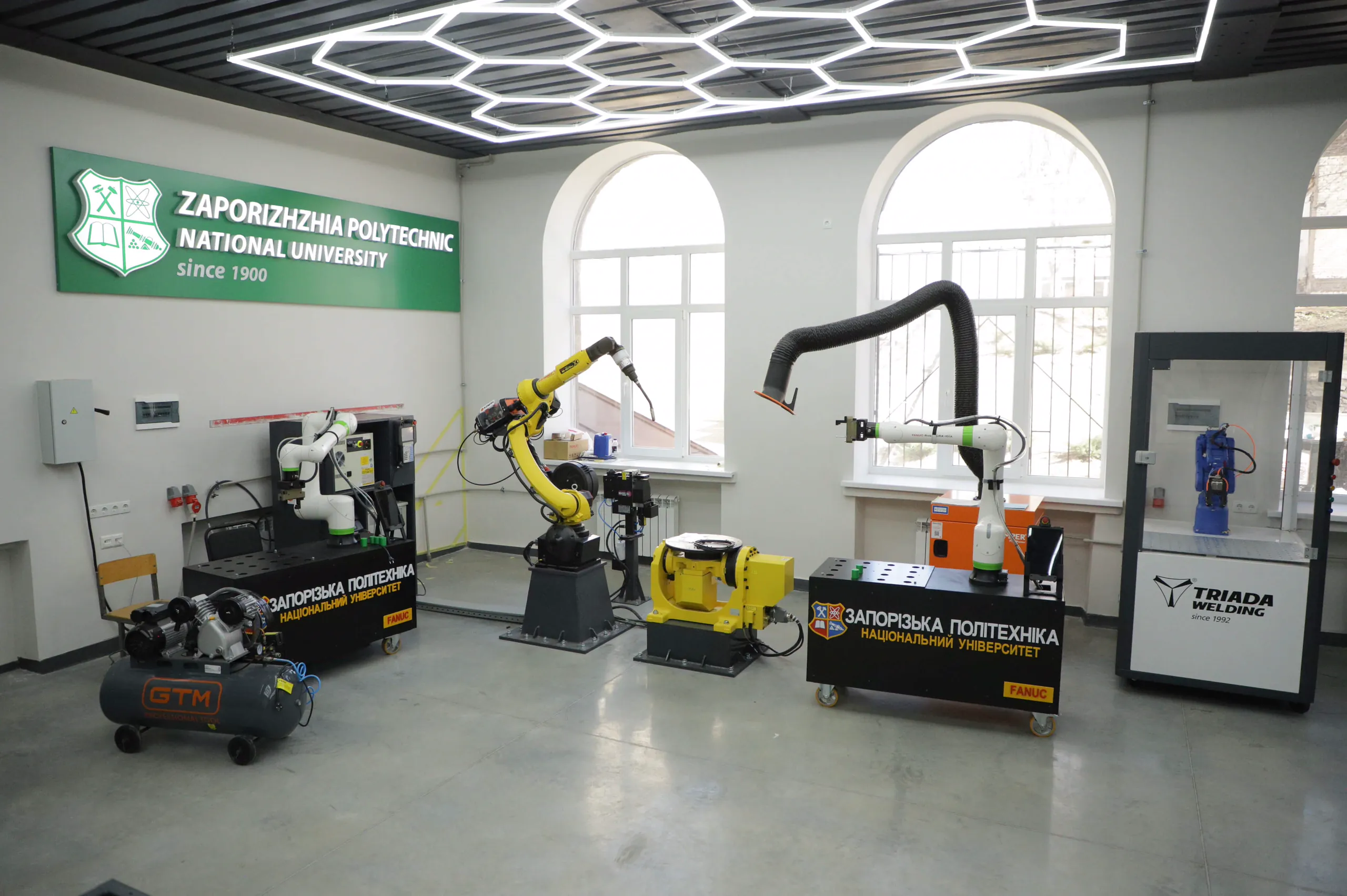
Сollaborative robot FANUC CRX-10iA
FANUC CRX-10iA is a modern six-axis collaborative robot designed for flexible automation, industrial robotics training, human-robot interaction research, and modeling of intelligent manufacturing processes.
At the HI-RISE Center, this robot complements the industrial welding complex and expands its functionality in the direction of collaborative robotics, flexible manufacturing, computer vision, adaptive control, and safe human-robot interaction.
If the industrial robot FANUC ARC Mate demonstrates the classical approach to high-precision automated welding, then the FANUC CRX-10iA represents a new generation of robotic systems focused on simple programming, rapid reconfiguration, and operation in variable production scenarios.
Technical Specifications
| Parameter | Value |
| Equipment Type | collaborative industrial robot |
| Number of Axes | 6 |
| Maximum Payload | 10 kg |
| Maximum Reach | 1249 mm |
| Repeatability | ±0.04 mm |
| Mechanical Unit Weight | approx. 40 kg |
| Maximum Speed: in collaborative mode in high-speed mode | 1000 mm/s 2000 mm/s |
| J1 Range | 380° |
| J2 Range | 360° |
| J3 Range | 570° |
| J4 Range | 380° |
| J5 Range | 360° |
| J6 Range | 450° |
| Allowable Moment J4 | 34.8 N·m |
| Allowable Inertia J4 | 1.28 kg·m² |
| Allowable Moment J5 | 26 N·m |
| Allowable Inertia J5 | 0.9 kg·m² |
| Allowable Moment J6 | 11 N·m |
| Programming Type | manual teaching, intuitive graphical programming |
| Main Application Areas | training, pick-and-place operations, sorting, part feeding, quality control, human-robot interaction, flexible manufacturing |
For the CRX-10iA, a payload of 10 kg, reach of 1249 mm, repeatability of ±0.04 mm, weight of approx. 40 kg, collaborative speed up to 1000 mm/s, and high-speed mode up to 2000 mm/s are provided. The CRX series also supports manual teaching, safe contact stop, and intuitive graphical programming on the touch pendant.
Purpose
The FANUC CRX-10iA is designed for automating operations that require flexibility, rapid reconfiguration, and convenient interaction with the operator. This equipment is particularly effective where full rigid automation is impractical or insufficiently flexible: in training laboratories, research areas, small-batch production, demonstration production cells, and frequently changing processes.
The cobot can perform repetitive, auxiliary, or preparatory operations, reducing the load on humans and increasing process stability. Its value lies in its ability to be quickly adapted to new tasks without lengthy redesign of the entire production system.
For the HI-RISE Center, the FANUC CRX-10iA is not just a separate robot, but a platform for demonstrating modern automation logic: human, robot, sensors, digital model, and production equipment working as a single integrated system.
Application Capabilities
Training in the basics of industrial robotics
The FANUC CRX-10iA is a convenient platform for students’ first acquaintance with industrial robots. Thanks to manual teaching and a graphical programming interface, students can quickly move from theoretical concepts to practical work with real equipment.
Based on it, one can study the structure of the robot, coordinate systems, workspace, TCP point, types of movements, programming logic, tool configuration, safe operation rules, and interaction with peripheral equipment.
A special feature of the cobot is the ability for intuitive trajectory teaching: the operator can manually move the robot to the required points, save them in the program, and form a sequence of operations. This significantly simplifies initial training and makes robotics accessible to students of various specialties.
Demonstration of human-robot interaction
The collaborative robot allows modeling scenarios in which a human and a robot work in the same technological space. This is one of the key areas of modern automation, as the robot not only replaces manual labor but also becomes an operator’s assistant.
Based on the CRX-10iA, one can demonstrate the distribution of functions between human and robot, safe execution of joint operations, workplace ergonomics, speed limitations, contact stop scenarios, risk assessment, and principles of organizing a collaborative production site.
Such capabilities are important for training engineers who must understand not only robot programming but also the full logic of safe integration of a robotic system into a production environment.
Part feeding, handling, and sorting
The CRX-10iA can be used for part feeding operations, workpiece handling, sorting, stacking, servicing work zones, and auxiliary logistics inside a production cell.
In training and demonstration scenarios, the cobot can feed blanks to the work area, move parts after the operation is completed, sort objects by shape or position, stack elements into cassettes or containers, simulate production logistics, or work as an auxiliary manipulator next to the main industrial robot.
This allows the creation of realistic models of flexible production processes in which automation covers not only the main technological operation but also auxiliary actions that affect the productivity of the entire system.
Auxiliary operations in the welding cell
As part of the robotic welding complex at the HI-RISE Center, the cobot can perform auxiliary functions for the main industrial robot FANUC ARC Mate. For example, it can feed samples, move small workpieces, simulate the work of an auxiliary manipulator, feed tooling elements, or participate in multi-robot training scenarios.
This combination allows demonstrating the principles of complex automation, where the main robot performs the technological operation and the collaborative robot provides auxiliary processes. For students, this is important because a modern production site is usually a system of interconnected devices, not an isolated robot.
Quality control and computer vision
The FANUC CRX-10iA can be integrated with a camera or machine vision system to perform quality control tasks, object recognition, and correction of robot actions based on visual analysis results.
In such scenarios, the robot can move the camera over the part, change the viewing angle, capture surface images, check for the presence of elements, control the correct placement of the workpiece, or perform preliminary visual inspection.
This creates a foundation for training and research in the field of computer vision, AI-based automation, adaptive control, and intelligent manufacturing systems. Students can see how the robot transitions from executing a fixed program to reacting to data from the external environment.
Modeling of flexible production sites
The CRX-10iA enables the creation of training models of flexible production sites that can quickly change for new tasks. Today the cobot can perform pick-and-place operations, tomorrow — part sorting, later — work with a camera or auxiliary operations in the welding cell.
It is this ability for rapid reconfiguration that makes collaborative robots particularly relevant for modern industry, where the role of small-batch production, rapid prototyping, personalized products, and adaptive manufacturing processes is growing.
Educational Value
In the educational process, the FANUC CRX-10iA allows the development of practical competencies in applied mechanics, industrial robotics, automation, mechatronics, robot programming, digital manufacturing, and the safety of robotic systems, among other areas.
The cobot is particularly valuable for interdisciplinary learning. It allows demonstrating robotics not as a narrow field of programming, but as a comprehensive engineering discipline at the intersection of mechanics, electronics, technology, sensorics, software, and production organization.
Based on the CRX-10iA, laboratory and practical classes can be conducted on the following topics:
| Learning Direction | Content |
| Basics of industrial robotics | robot axes, workspace, coordinate systems, TCP |
| Programming industrial robots | points, trajectories, types of movements, program execution logic |
| Manual teaching | creating trajectories through direct robot movement |
| Pick-and-place operations | gripping, moving, and stacking parts |
| Collaborative interaction | scenarios of joint human-robot work |
| Computer vision | object position recognition, quality control, trajectory correction |
| Safety | speed limitations, risk analysis, collision prevention |
| Flexible manufacturing | rapid reconfiguration of operations and modeling of a production site |
Research Potential
The FANUC CRX-10iA opens up wide opportunities for applied research in the field of collaborative robotics, human-robot interaction, flexible manufacturing systems, computer vision, and intelligent automation.
Scientific research based on the cobot may cover:
- modeling scenarios of human-robot collaboration (Human-Robot Collaboration, HRC);
- ergonomics of robotic workplaces;
- function distribution between operator and robot;
- collaborative assembly;
- automated part handling and sorting;
- integration with computer vision;
- adaptive sensor-based control;
- use of AI algorithms for object recognition;
- digital scenarios of interaction between operator, robot, and production environment;
- evaluation of the effectiveness of partial automation for small and medium-sized enterprises.
In combination with other HI-RISE Center equipment, the cobot is used to build complex research scenarios: from auxiliary operations in the robotic welding cell to creating models of intelligent manufacturing systems using sensors, digital data, and artificial intelligence algorithms.
Significance for the HI-RISE Center
The FANUC CRX-10iA expands the educational and scientific capabilities of the HI-RISE Center beyond classical robotic welding. It demonstrates a modern approach to automation, where not only precision and productivity are important, but also flexibility, safe interaction with humans, rapid reconfiguration, digital integration, and adaptability to new production tasks.
The presence of this cobot creates a modern educational and research environment at the HI-RISE Center focused on training a new generation of engineers. Such specialists must be able not only to program a robot but also to design robotic systems, integrate them with peripherals, assess safety, work with data, apply computer vision, and understand the logic of flexible digital manufacturing.
FANUC CRX-10iA is a platform for practical training, applied research, and demonstration of modern approaches to collaborative robotics, Industry 4.0, and Smart Manufacturing.