ZNTU Rating by CEDOS


The CEDOS Analytical Center conducted a rating of 96 national universities of Ukraine during October 2014 – March 2015. The top ten included:
- National University «Lviv Polytechnic» (71.3 points);
- Kharkiv National University named after Karazin (66.9);
- Ternopil National University named after Pul (62.6);
- Lviv National University named after Ivan Franko (59);
- Kyiv National University named after Taras Shevchenko (57.1);
- National Technical University of Ukraine «Kyiv Polytechnic Institute» (56.1);
- Lviv National Medical University named after Danylo Halytskyi (55.5);
- Kyiv National University of Trade and Economics (54.9);
- Precarpathian National University named after Vasyl Stefanyk (54.7);
- Khmelnytskyi National University (54.3).
Our university took 32nd place in the ranking. That is, it is at the top of the rating list.
To fill in the websites of departments, institutes and other structural units of the university, we present the methodology for calculating the rating, according to the version of the CEDOS analytical center, which is supported by the Ministry of Education and Science of Ukraine.
Methodology for the transparency rating of national universities
Sources of information. The rating uses university websites as the main source of information and measures the fact of the presence or absence of certain information on them. Also, the source of information is the fact of satisfaction/dissatisfaction of a request for public information.
The monitoring covered all national universities, except those located in the occupied territories, as well as universities of law enforcement agencies. In total, 96 national universities are represented in the rating.
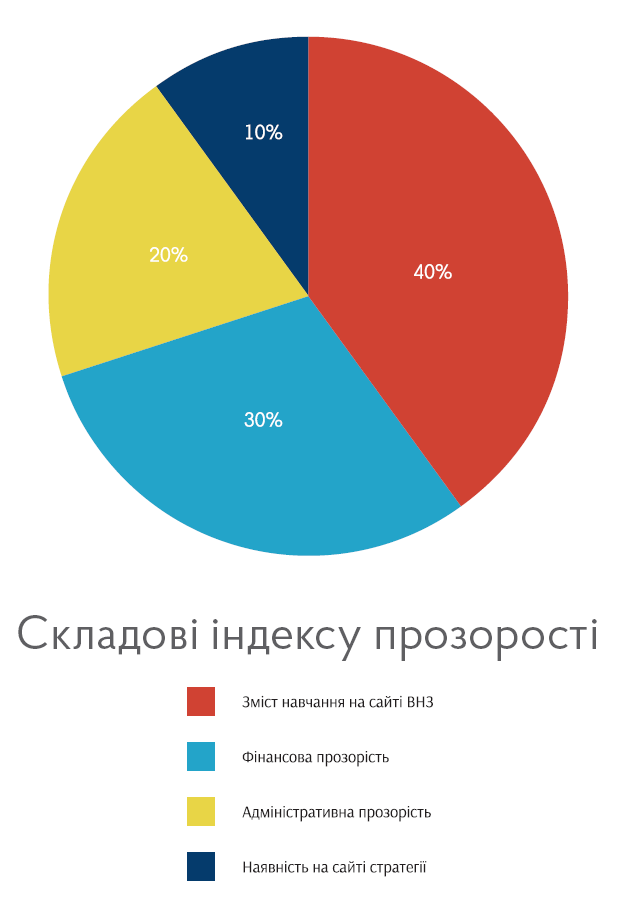
Financial transparency (30%)
The indicator primarily reflects the extent to which universities comply with the requirements of the Law «On Higher Education» and the Law «On Access to Public Information» regarding the publication of their financial documentation in the public domain or providing it upon request.
Publication of financial documents on the university website:
- the university’s budget for 2014 or 2015 – 4 points;
- a report on the use and receipt of funds for 2014 – 4 points; 4 points;
- staff list of the university for 2014 or 2015 – 4 points (consolidated staff list – 2 points).
Publication of information on state procurement on the university website for 2014 – 2 points.
Availability of information on the amount of fees for the entire period of study:
- in Ukrainian – 2.5 points;
- in English – 2.5 points.
Availability of information on the amount of fees for the provision of additional educational services – 2 points.
Response to requests for public information:
- the budget of the university for 2013 with changes – 1.5 points, as well as a report on the use and receipt of funds for 2013 – 1.5 points;
- the staff list of the university for the current year – 3 points (summary staff list – 1.5 points);
- information on the number of students (budget and contract employees) – 1.5 points;
- information on the number of full-time scientific and pedagogical and pedagogical employees and part-time employees – 1.5 points (summary or incomplete information – 1 point).
During October 2014 – March 2015, monthly monitoring of university websites was carried out; if the mentioned information was recorded on the website during this period, the university received the corresponding score. If the information was published after the order of the Ministry of Education and Science No. 166 dated February 19, 2015, the maximum score was halved.
Administrative transparency (20%)
The indicator reflects the extent to which the university fulfills the requirements of the Law «On Higher Education» regarding the openness of the main provisions of the university and information about its governing bodies, as well as the extent to which the university adheres to transparency in its personnel policy, in particular when announcing competitions for vacant positions.
Presence on the university website:
- of the university’s charter – 4 points;
- regulations on the Academic Council – 2 points;
-
information about the senior management (rectorate):
- composition – 1 point,
- contact details of members – 1 point,
- reception hours of its members – 1 point,
- composition of the Academic Council of the university – 2 points,
- composition of the last meeting of the labor collective – 1 point,
- annual report of the rector – 2 points,
- announcements of vacant scientific and pedagogical positions on the university website – 3 points.
Responses to two requests for public information on the presence/absence of vacant positions – 1.5+1.5 points.
During October 2014 – March 2015, university websites were monitored monthly. If the aforementioned information was recorded on the website during this period, the university received the corresponding score. The score for the announcement of vacant positions depended on the university’s response to our request about their availability. If during the specified period the university did not hold a competition to fill vacant positions, then the maximum possible number of points for this indicator was counted, adjusted by a coefficient that was calculated as the ratio of the sum of the points scored to the maximum possible sum of points for all other parameters of the indicator. If the university did not respond to the requests and there were no announcements on the website – for the announcements parameter, the university received 0 points.
If the publication of information took place after the order of the Ministry of Education and Science No. 166 of 19.02.2015, the maximum score was halved.
Availability of a strategic development plan on the university website (10%)
The indicator reflects whether the university carries out strategic planning, and also shows the presence of main components in the strategy.
Coverage of the following areas of activity in the strategic development plan:
- information on ensuring the quality of education – 1 point;
- research activities – 1 point;
- formation (raising funds) and budget allocation – 1 point;
- staff development, in particular, promoting the career development of young teachers – 1 point;
- international activities – 1 point;
- infrastructure development – 1 point.
The presence of the following components in the strategic development plan:
- strategic goals – 1 point;
- projects, activities and operational objectives on the basis of which the strategic goals will be achieved – 1 point;
- indicators on the basis of which the implementation of strategic goals can be verified, – 2 points.
During October 2014 – March 2015, monthly monitoring of university websites took place, if the mentioned information was recorded on the website during this period, you received the corresponding score.
Information about the content of education on the university website (40%)
The indicator shows the extent to which the university uses its website to inform about the content of its own educational programs, personnel potential and evaluation system.
Description of the curriculum, namely:
- list of disciplines – 7 points,
- a brief description of the purpose of the discipline, the knowledge and skills it provides – 3 points,
- information about the number of hours or the number of ECTS credits within the framework of information about disciplines – 3 points,
- types of works within the framework of information about disciplines – 4 points,
- distribution of assessment within the discipline – 4 points,
- who exactly teaches these disciplines – 5 points.
Availability of information on internship opportunities – 4 points (for the university or faculty in general) or 6 points (for each department/program).
ECTS information package – 3 points (for the university or faculty in general) or 5 points (for each department/program).
English-language ECTS package – 2 points (for the university or faculty in general) or 3 points (for each department/program).
During October 2014 – March 2015, monthly monitoring of university websites took place. If the mentioned information was recorded on the website during this period, you received the corresponding score. Monitoring covered full-time bachelor’s programs, with the exception of the National Academy of Management (master’s programs).
Evaluation of the curriculum description took place at each faculty/institute. First, the maximum score of each parameter was divided by the number of departments (less often – programs) at the faculty. Then the obtained number was multiplied by the number of departments (programs) that have the corresponding measurable component. And so for each parameter. Then all the points received by the faculty were added. After that, the points received by each faculty were added and divided by the number of faculties.
According to the same principle, points were calculated for the parameters of information about practice and the information package of ECTS. The only difference was that the maximum number of points for these parameters, if the information was posted for the entire faculty or university, was reduced.
For art universities, the maximum possible number of points for this indicator was counted as a component of information about practice, adjusted for the coefficient, which was calculated as the ratio of the sum of points scored to the maximum possible sum of points for all parameters of the curriculum description.
General university departments of both the humanitarian and technical profile, military departments, separate units, as well as faculties for foreign students did not participate in the monitoring (except for the parameter regarding the English-language information package of ECTS). If the department provides general discipline for only one faculty, then it was also taken into account.
If the evaluated information was only in the internal network of the university, it was not taken into account, because interested applicants do not have access to it.
If the information about the educational program that was subject to monitoring was contained in the ECTS information package, it was taken into account in the same way as that posted on the page of the department or faculty.
Information about practice was taken into account only if specific enterprises and institutions for its completion were specified.
The presence of the ECTS information package was taken into account provided that it contained at least 60% of the information listed below:
- general description of the university (including type and status);
- list of programs offered by the university;
- general registration and enrollment procedures;
- information on advisory assistance to students;
- cost of living;
- housing;
- nutrition;
- medical care;
- opportunities for students with special needs;
- insurance/financial provision (support) of students;
- department of student affairs;
- conditions for training;
- international programs;
- practical information for mobile students;
- language courses;
- practice;
- conditions for sports and leisure activities;
- student organizations.
Posting on the official website of the educational institution the list and description of the courses taught, the characteristics of the teachers who teach them, are important for several reasons. First of all, in this way, the university shows exactly what future students will study. This is necessary both so that applicants can make an informed choice when choosing a university and specialty (and this, in turn, will mean more motivated and better prepared applicants), and so that employers can assess what specific knowledge and skills graduates of various specialties will receive. Such information is no less beneficial for the students themselves, who independently choose a quarter of the volume of the educational program.
This component of the university’s information policy becomes especially relevant in the conditions of the current reform of higher education, because from now on the state standards will contain only the final competencies that a student must master, and the content of educational programs will depend on the university. Therefore, at different universities, students of the same specialty can be taught differently, and each university is interested in showing the uniqueness and advantages of its programs.