Review workshop from a crisis psychologist on psychosocial support for military personnel, veterans, survivors of captivity and torture, and families experiencing an uncertain loss

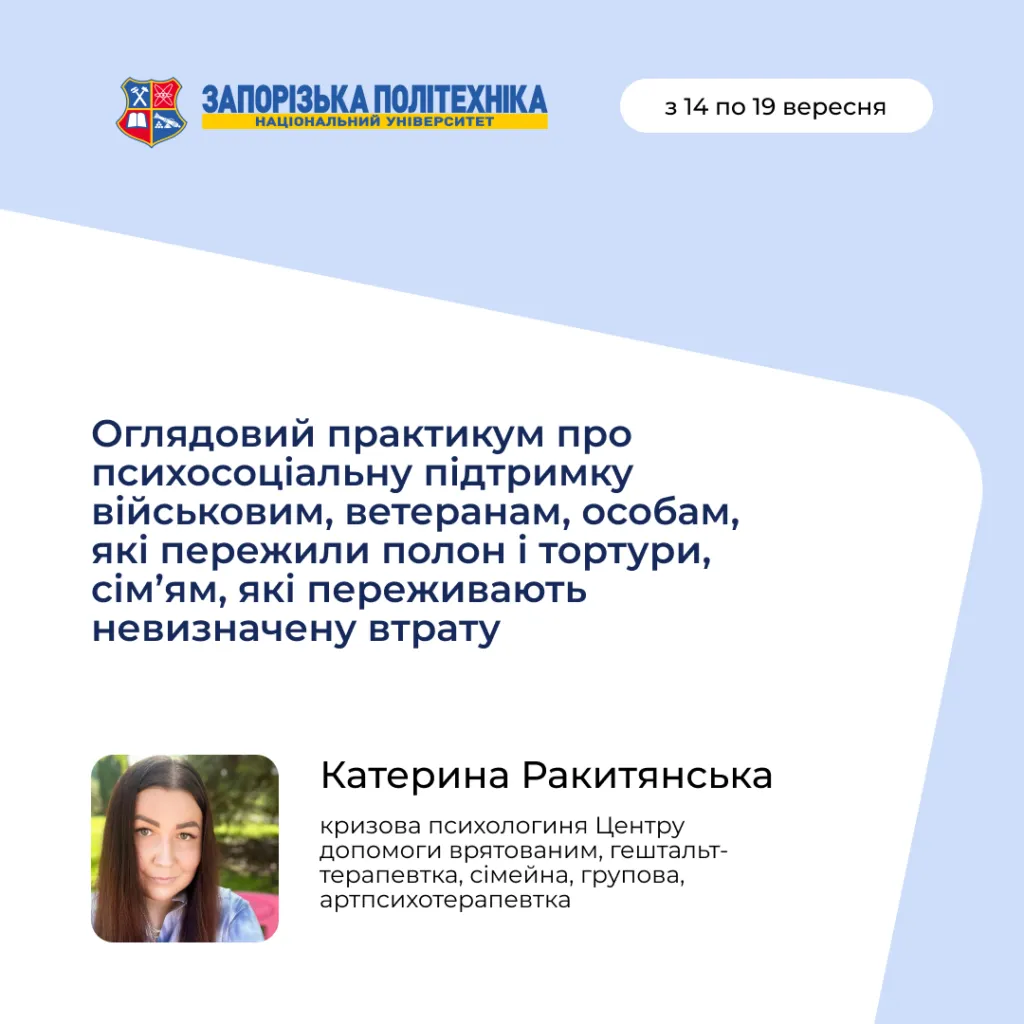
Within the framework of the project «Healthcare and psychosocial support services for the population affected by the conflict in Ukraine», the Department of Psychology, as a co-organizer, invites everyone to a review workshop from Kateryna Rakytyanska – crisis psychologist of the Center for Assistance to Survivors, Gestalt therapist, family, group, art psychotherapist, graduate of the Department of Psychology of the Zaporizhzhia Polytechnic National University.
Practical events will be held from 5:00 PM to 6:00 PM in September 2024.
- September 14 — «Features of interaction and provision of psychosocial assistance to military personnel».
- September 15 — «Identification of veterans’ needs and psychosocial assistance in adaptation».
- September 16 — «Features of working with families experiencing an indefinite loss».
- September 17 — «Psychological assistance to families expecting military personnel».
- September 18 — «Features of psychological assistance to people who have survived captivity and torture».
- September 19 — «Behavioral, emotional and psychological manifestations of military personnel and veterans and provision of assistance according to the observed features».
Registration via the link: https://bit.ly/4gjYpAt
Please note that you must choose ONE event from the ones offered in which you want to participate. The number of participants in each event is limited (10 people).
Venue: 39 Nezalezhnoi Ukrainy Street, intercom 38, floor 2, office 213 (entrance from the road).
Landmark: Shevchenko Boulevard stop.
After the event, each participant will receive a certificate from Zaporizhzhia Polytechnic University.
This project is implemented by the public organization Crisis Support Center «Together» in cooperation with the non-governmental, non-profit, non-religious global humanitarian organization ACTION CONTRE LA FAIM/ ACTION AGAINST HUNGER (ACF) and with the support of the United States Agency for International Development (USAID) in cooperation with the Department of Psychology of Zaporizhzhia Polytechnic University.