Survey of graduates of bachelor’s educational programs of the Software Department


The Department of Software of the National University "Zaporizhzhia Polytechnic" conducted a mass survey of graduates of bachelor’s educational programs, in which 114 people (76%) out of 150 fourth-year students participated. Among the surveyed respondents, the following bachelor’s degree programs were studied: 121 Software Engineering – 60.5%, 122 Computer Science – 39.5%. The form of payment for bachelor’s degree studies: from the state budget – 72.8%, under a contract – 27.2%. 97.4% studied full-time, and 12.5% studied part-time. 2.6% of respondents.
The usefulness of studying in the specialty at the university was assessed by respondents as: satisfied – 94.7% (including completely satisfied – 50%, satisfied in general, but need to strengthen theoretical training – 1.7%, satisfied in general, but need to strengthen practical training – 43%), dissatisfied – 5.3%.
Respondents believe that in general their acquaintances perceive the Department of Software Tools: better than other departments – 57%, at the level of other departments – 43%, worse than other departments – 0%. According to respondents, the attitude towards most students by most teachers of the Department of Software Tools is: good – 100%, bad – 0%. Regarding themselves personally, the attitude of the teachers of the Software Department is assessed by the respondents as: good – 99.1% (including completely satisfied with the attitude of all teachers – 76.3%, satisfied with the attitude of most teachers – 22.8%). Regarding the attitude of most students towards most teachers of the Software Department, according to the respondents, it can be assessed as good – 97.4%.
Further study in the master’s program is planned by 78.9% of respondents (as acceptable forms of payment for further study in the master’s program are indicated: only at the expense of the state budget – 33.3%, under a contract – 44.6% (including only under a contract – 2.6%, both at the expense of the state budget and under a contract – 43%)), do not plan to enter the master’s program – 21.1%. Of the respondents who plan to enter the master’s program, they are going to enter: NU «Zaporizhzhia Polytechnic» – 78.1%, other universities of the Zaporizhzhia region – 2.6%, other universities of Ukraine – 0.88%, foreign universities – 1.8%. They indicated that they plan to enter a master’s degree in the specialty: 121 Software Engineering – 57%, 122 Computer Science – 39.5%.
Among the respondents, 9.7% took paid foreign language courses to prepare for the EFVI – 90.3%. At the same time, they indicated the following self-assessment of their level of foreign language proficiency: high – 17.5%, average – 59.7%, low – 17.5% 22.8%
At the time of the survey, 54.4% were employed (including at enterprises – 14.9%, as an individual entrepreneur – 13.2%, without official registration (freelance) – 26.3%), unemployed – 45.6% of respondents.
Respondents working at enterprises indicated as their place of work: Computools, Incode Group, SoftServe, Ukrosoft Group, CHI Software, Extrums, CUDEV, Development Intellect, CookieDev, Svitla Systems Inc., Drum'N'Code, GBKSOFT, X-Torus, Phonexa, "Synapse Team" LLC, METRO, Fozzy-Food, Zolotiy Vik, "Sribna Kraina" LLC, "ZAlK" JSC, "Privat Bank", "Nova Poshta", "Center for Sociological Research", "Lendfort-Azov" LLC, "HYUGGE Dent", "Omega" LLC, as well as educational institutions.
After graduating from university, 90.4% plan to work in their specialty (including 60.5% – because they are interested in the specialty, 29.8% – if they find a job in their specialty), do not plan to work in their specialty – 9.6%.
After graduating from university, they plan to work in the Zaporizhzhia region – 66.7%, in other regions of Ukraine – 22.8%, abroad – 10.5% of respondents.
Only 24.6% of respondents will need help with employment.
32.5% of respondents plan to open their own business (enterprise) after graduating from university, already have their own business (enterprise) – 5.3%, do not plan to open their own business – 52.6%, need help in solving the issue of opening their own business – 9.6%.
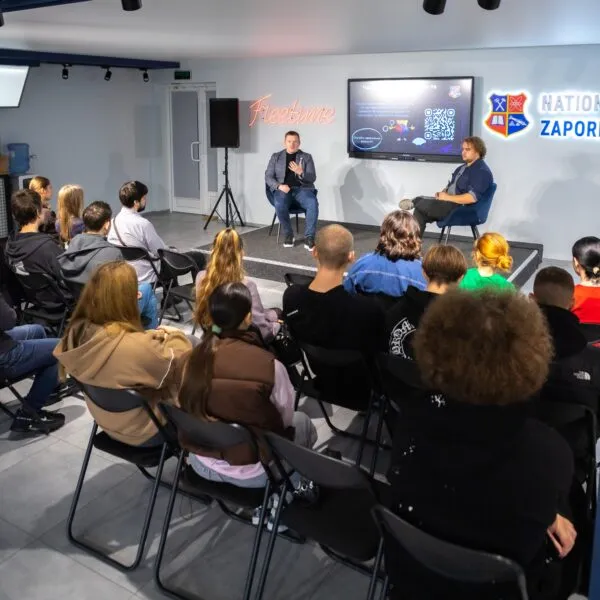
Among the respondents, 57.9% attended meetings with representatives of IT companies based on the Department of Software Tools (including 45.6% benefited from this), did not attend – 42.1% (including consider it useful – 31.6%). Attended the Job Fair at NU "Zaporizhzhia Polytechnic" 29.8% (including consider it useful – 21.9%), did not attend – 70.2% (including consider it useful – 55.3%). Visited the Center for Promoting Student Employment at NU "Zaporizhzhia Polytechnic" 16.7% (including 13.2% who benefited from it), did not attend – 83.3% (including 64% who consider it useful). Attended external events (forums, hackathons, meetups, competitions, etc.) during their studies at the university 61.4% (including 54.4% who benefited from it for themselves), did not attend – 38.6% (including 29.8% who consider it useful).
During their studies, respondents underwent internships/training: at enterprises – 86.8% (including at a place of practice found independently – 52.6%, at a place of practice offered by the university – 34.2%), at the university – 13.2%.
Respondents suggested making the following changes to the educational process for the educational programs (specialties) of the department: take into account the best practices of foreign universities, continue to update the content of educational courses, ensure their orientation to the needs of the regional labor market, increase attention to studying English, reduce the number and volume of studying non-core (primarily – humanitarian) disciplines, increase practical training in the specialty, increase theoretical training in the specialty, strengthen the study of new languages and programming technologies, ensure a case-oriented approach to learning, ensure a more in-depth study of disciplines in the specialty, continue to update the teaching staff and material and technical base (in particular, computer equipment), train students to work in a team, ensure the involvement of practical specialists in teaching, ensure greater freedom in forming an individual trajectory of student learning, in particular through individual choice of programming languages when performing laboratory work, the formation of selective blocks of interrelated disciplines in blocks that will allow each student to choose a specialization, increase students’ motivation to study by presenting the material in a more interesting way, promote the organization of students’ leisure by organizing excursions and other events, including professionally oriented programming competitions, and promote student employment.
Respondents suggested the following actions to promote employment of students and graduates of the Department of Software: continue holding meetings with representatives of companies at the department, involve company owners in such events, increase the number and volume of internships at enterprises, organize master classes and trainings, pay attention not only to regional, but also to metropolitan and foreign companies, expand cooperation with companies, attract more employers, provide students with information about current areas of work and professions and a list of current technologies (requirements) in each area.
Respondents suggested the following advice on measures for working with applicants: explain to applicants the relevance of the department’s specialties and educational programs, detail the advantages of studying at the university and at the department, inform applicants about the opportunities and statistics of admission under a state order, provide examples of student and graduate developments, describe prospects employment of students and provide examples of successful employment of graduates of the department’s specialties, track and publish data on the fate of graduates working in the specialty, organize a professional PR company for the university and department in the region, disseminate information about the department and its specialties in the media, the Internet, and in schools in the city and region, create and distribute interactive electronic presentations of the department and its specialties, continue holding open days and excursions for schoolchildren to the department, and distribute information booklets for applicants.
The results of the survey are generally consistent with the results of previously conducted surveys of graduates Master’s degree and students of non-graduate courses.
The Department of Software, implementing the best practices recommended by the National Agency for Quality Assurance in Higher Education, will continue to study the opinion of students and take it into account in planning the work of the department, and will bring it to the attention of the university management and the general public.
S.O. Subbotin
Head of the Department of Software