Academic mobility of students of the Department of Software to European universities under the Erasmus+ program

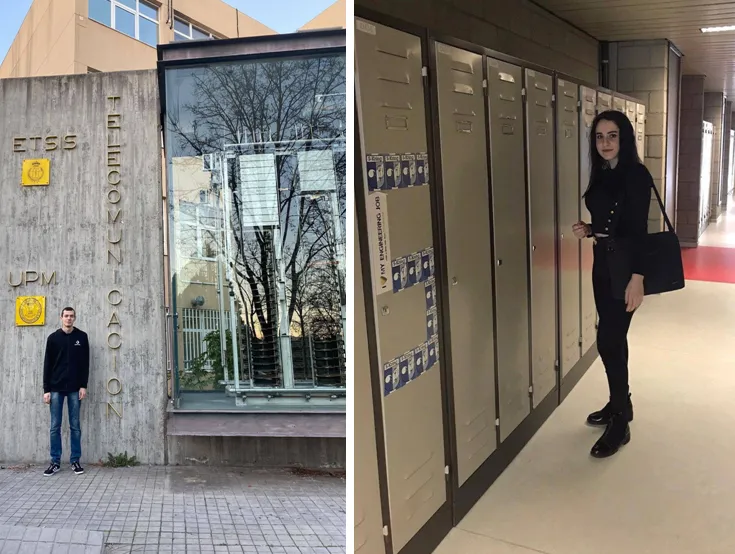
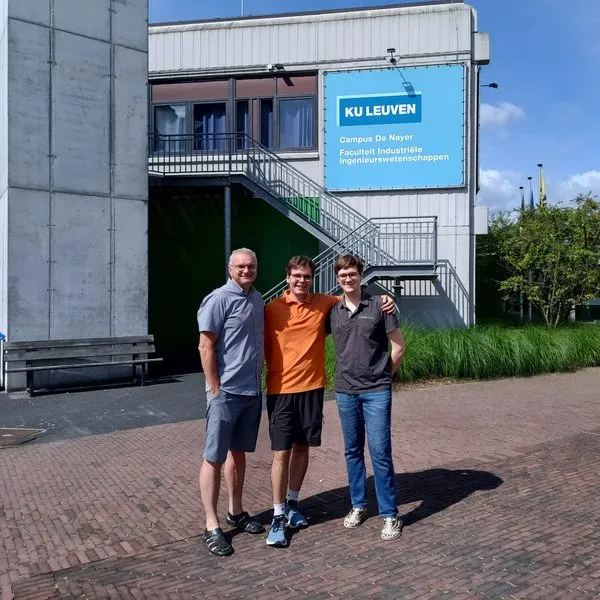
In the spring semester of 2019-2020, for five months, a student of the Department of Software I. Lymarev studied at the Madrid Polytechnic University (Spain), and a student of the Department of Software N. Jragatspanyan studied at Thomas More University (Belgium).
I. Lymarev’s impressions are as follows.
Campus Sur, where I studied, was very comfortable and modern. In addition to classroom equipment, there is also the opportunity to take the necessary equipment for learning home, which I used when preparing my Master’s thesis.
Of course, the quarantine made adjustments to my studies. However, the remote learning process was quickly established and it really did not differ much from the offline learning that took place during the month before the quarantine.
The master’s program I studied in (Master Internet of Things) is very practically oriented. As I learned, in Spain there are scientific and practical master’s programs, which differ significantly from each other in content and teaching style. The advantage of my program was that classes always started at 5:30 PM, so that students could work and study. In classes, teachers tried to keep lectures short, always accompanying them with presentations, which, like all other course materials, were available in Moodle. The main focus of the classes was practical individual work.
I consider the most useful for me to be working on my Master thesis. I was extremely lucky with my supervisor. We had meetings every week, first offline and then online. The university administration is also very friendly, they helped me extend the terms of my mobility and paid a scholarship for additional time due to quarantine, so that I could finish my work. I worked with a new area for me, related to biosensors and biosignals. It turned out to be very interesting for me. And using its example, I significantly improved my technical writing skills in English, which I generally consider the most useful over the past six months, because it is very difficult to learn in Ukraine without special education.
Life in Spain is inexpensive compared to other EU countries. Food prices in supermarkets are relatively the same as in Ukraine, some a little cheaper, some more expensive. Transport is generally very cheap. For anyone under 26 years old, a 30-day unlimited travel pass on any transport throughout the Province of Madrid costs only 20 euros. Madrid is a very beautiful and large city, it remains a mystery to me why it is not as popular with tourists as Paris or Rome, because I didn’t manage to see everything here even in six months. Despite the quarantine, in my free time I also visited other famous cities in Spain: Barcelona, Valencia, Palma de Mallorca.
At the beginning of my life in Spain, I knew only a few words of Spanish. Now I can understand most of the information in the city and communicate on everyday topics, on the street, in a shop, in a cafe. The university provided the opportunity to take two language courses (levels A1 and A2), and in a language environment the level increases quickly. I am very satisfied with my studies in Spain and grateful to all my teachers who taught and helped me.
N. Jragatspanyan’s impressions are as follows.
I studied at the modern Thomas More University, which has everything for the development of students.
Unfortunately, the coronavirus had a big impact on my activities in Belgium, as most of my studies were done remotely due to the quarantine. But despite the online learning regime and other restrictions imposed to prevent the spread of the virus, I was able to fully enjoy life in a new country for me. In Belgium, I got to know a completely different education system and was in a multi-ethnic educational environment.
People in Belgium are very friendly. Despite the fact that they themselves had a hard time during the quarantine, they still offered and provided help to those in need. I lived on campus and was not left without attention, we were often given masks and other things needed during the quarantine.
I was delighted when I learned that during the quarantine, Belgians started putting teddy bears near the windows so that people passing by their houses would not be so sad. Indeed, when you walk down the street and see how children look at houses and look for teddy bears, competing to see who can count the most, it’s hard not to smile! I also really liked how the Belgians unanimously applauded the doctors who were on the front lines of the fight against the virus every day at 8:00 PM.
The experience of independent living and studying in another country is incomparable, no book can explain to a person what he will be able to understand and feel on his own if he finds himself in such an environment. I am grateful to the Erasmus+ program for such a valuable experience, for the skills acquired in Belgium that will help me in my future life.
The Department of Software provides students and teachers with opportunities for academic mobility to leading European universities, in particular Belgium, Spain, Germany, Romania, Poland. Combining studies at the Department of Software of the Zaporizhzhia Polytechnic National University with mobility to foreign universities provides students with ample opportunities for further study, employment and career development.
S.O. Subbotin
Head of the Department of Software Tools