About commemoration of the Memorial Day of the Holodomor victims of 1932-1933 in Ukraine

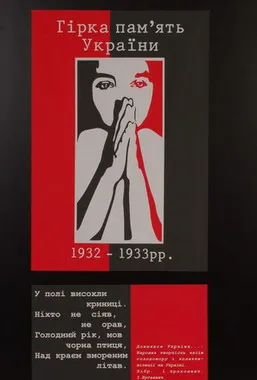
The history of Ukraine of the 20th century is «a new Apocalypse, a new »Dante’s Hell«, as Oleksandr Dovzhenko wrote in his »Diary«. »When I think about what happened and what is being done, how much suffering, injustice, death, inhuman, unearthly cruelty, hellish torments, unheard of rage, torture, lies, hidden sorrows, lies, exiles and executions. How much dislike for the people and fear of its restless spirit! My God… How many spiritually and physically broken hearts. Fifteen million corpses and exiles. I don’t know anything scarier in the world« (22.IX.1945. O.P. Dovzhenko. »Diary«).
At the end of November, in accordance with the Decree of the President of Ukraine No. 1310 of November 26, 1998 »On the Establishment of the Day of Remembrance of the Victims of the Holodomor« (as amended by the Decree of the President of Ukraine No. 431 of May 21, 2007), the memory of the victims of the Holodomor of 1932-1933 is commemorated in Ukraine. We offer excerpts from some documents published in the collection of documents »Famine of 1932-1933 in Ukraine: through the eyes of historians, in the language of documents” (K., 1990):
No. 11
FROM THE RESOLUTION OF THE BUREAU OF THE KYIV REGIONAL COMMUNITY KP(b)U
ABOUT THE WORK REGARDING THE COLLECTION OF SEED FUNDS
February 18, 1932
The directive of the Central Committee of the CP(b)U and the People’s Commissariat of People’s Commissariat in the matter of seed funds should be accepted for strict guidance and implementation.
Instruct the secretariat within one day to draw up, on the basis of the directive of the Central Committee of the CP(b)U and the Radna People’s Committee, a corresponding telegraphic directive to all district party committees of the region regarding the immediate deployment of Bolshevik work on the collection of seed funds in order to fully ensure the spring sowing campaign, noting the immediate termination of any talks about seed aid from the center and directing all the attention of the party organization to the collection of seed funds funds on the spot, on the mobilization of all internal resources and indicating to the RPK that all this work on collecting seed funds should be carried out alongside grain procurement, in no way affecting the reduction of the pace of such. Instruct the Agitmas Division to accordingly instruct the comrades working in the districts in the field of grain procurement that, along with grain procurement, the Bolshevik work to provide seed funds for the spring sowing campaign should be launched.
The famine of 1932-1933 in Ukraine: through the eyes of historians, in the language of documents / Ker. number according to R. Ya. Pie. – K.: Politvydav of Ukraine, 1990. – P. 120.
No. 12
LETTER OF THE CHAIRMAN OF THE ALL-UKRAINIAN Central Committee
G.I. PETROVSKY POLITICAL BUREAU of the Central Committee of the CP(b)U
ABOUT FOOD DIFFICULTIES IN A NUMBER OF DISTRICTS
Vinnytsia, Dnipropetrovsk, Kyiv,
ODESSA AND KHARKIV REGIONS AND EVENTS
CONCERNING THEIR OVERCOME
Not earlier than February 23, 1932
Politburo of the Central Committee of the Communist Party of Ukraine (b) Comrade Kosyor
In view of the fact that the food situation is already starting to become difficult for a number of districts of Dnipropetrovsk, Odesa, Kharkiv, Kyiv and Vinnytsia regions, and not only for villages, but also for some working towns, I consider it necessary:
1. Write a detailed note of the Central Committee of the CPSU(b) on the basis of the exchange of opinions at the Sowing Commission on February 23, in the presence of the secretaries of regional committees and the materials we have on this issue, about the facts of the acute shortage of food for the population and fodder for livestock.
2. Asks the Central Committee of the CPSU(b) to issue a decree on the termination of bread procurement in Ukraine and the declaration of free trade, according to the law.
3. Will entrust tt. Petrovsky, Wojciechovsky, and Gorlinsky to gather communist public organizations: professional organizations, «Drug detey», Red Cross to adopt a number of measures to help children in areas in a difficult food situation.
4. Procurement organizations, republican and cooperative organizations will discuss the possibility of decentralized procurement in some areas to help regions with food shortages.
H. Petrovsky
The famine of 1932-1933 in Ukraine: through the eyes of historians, in the language of documents / Ker. number according to R. Ya. Pie. – K.: Politvydav of Ukraine, 1990. – P. 121.
No. 13
RESOLUTION OF THE KHERSON CITY COMMITTEE KP(b)U
ABOUT BREAD PRODUCTION
March 1, 1932
a) It should be noted that almost all village councils completely stopped harvesting bread during the last ten days of February.
b) To state that this was caused in connection with the complete demobilization of the rural party organization and the representatives of the IPC and the city council.
c) To state, as a shameful phenomenon, that the contractors fulfilled the annual task by only 68%, and the planners by 76%.
d) To consider it necessary in the future, along with the preparation for the spring sowing campaign, to strengthen the work on the implementation of the bread procurement plan.
d) To suggest to the authorized representatives of the IPC and the secretaries of the agricultural and agricultural centers, in addition to the further deployment of mass work among collective farm workers and contractors, to take the most decisive measures of administrative and financial pressure on the malicious losers of bread.
j) To instruct the RKS faction to check on the collective farms the implementation of the party’s directive on harvesting surplus bread from collective farm workers.
g) To propose the factions of the city council to issue a directive on the opening of all mills in the area.
h) To instruct the prosecutor’s office and the national court to speed up the consideration of cases related to bread harvesting, examining them in villages in a demonstrative manner.
i) Listen at the office to the reports of the bread procurement commissioners of the following villages: Bilozerky, Ts. Dar, P. Pokrovsky, Muzikyvka and Stanislava.
The famine of 1932-1933 in Ukraine: through the eyes of historians, in the language of documents / Ker. number according to R. Ya. Pie. – K.: Politvydav of Ukraine, 1990. – P. 122.
No. 14
DIRECTIVE LETTER of the Central Committee of the CP(b) TO THE PARTY COMMITTEES,
TO THE MOLDOVA REGION, CITY COMMISSIONS
AND TO THE COUNTY COMMISSIONERS OF DONBAS ON THE PROGRESS OF THE MEETING
SEED FUNDS
March 6, 1932
The first. In view of the slow pace of seed fund collection and the existence of rumors among collective farmers in a number of districts and the fear that the collected seeds will be used for bread production – the Central Committee proposes to publish in the local press on behalf of the regional district bodies the following resolution: «Due to the need to focus all attention on the sowing campaign and seed collection, the bread production will be stopped and all those authorized for bread production will be recalled.» Our decision to transfer these authorized persons to other villages for the mobilization of seeds remains [in] force.
The second. Immediately publish a decree prohibiting the milling of spring wheat and, if necessary, select all spring wheat for sowing. Surplus spring wheat available [in] individual collective farms will be exchanged for winter wheat.
Secretary of the Central Committee of the CP(b) U S. Kosior
The famine of 1932-1933 in Ukraine: through the eyes of historians, in the language of documents / Ker. number according to R. Ya. Pie. – K.: Politvydav of Ukraine, 1990. – P. 123.
No. 15
REPORTING NOTE OF THE VINNITA REGIONAL COMMITTEE OF THE PARTY
CENTRAL COMMITTEE OF KP(b)U ON TRAINING
TO THE SOWING CAMPAIGN AND GATHERING
SEED FUND
March 7, 1932
Central Committee of the CP(b) in the town of Kosioru
Collection of seed material took place and is taking place slowly, in my opinion, for the following reasons:
1. Late delay in bread procurement.
2. In a number of districts in collective farms, seed material was taken to account for bread production (Plyskovsky, Tulchynsky and other districts).
3. Perekruchivaniya, which took place in a number of districts during the bread harvests, consisted in the withdrawal of all available grain, as well as those who fulfilled the contract plan.
4. The lack of seed material in many collective farms is explained by the fact that many collective farms distributed a significant part of grain as advances and for labor days, did not provide themselves with the necessary amount of grain for bread production, and therefore were forced to later transfer the remaining seed material to the account of bread production, in the hope of collecting the necessary amount for sowing from collective farmers, which in many cases did not give positive results.
5. Harvesting in the individual sector is slow, mainly because the absolute majority of the regions of the region in the individual sector have not fulfilled the bread procurement plan, and the requirement of the districts to hand over the seed to communal barns without conducting explanatory work created a danger that this grain will go to the account of the unfulfilled bread procurement plan.
6. To this must be added the distortion that took place in a number of districts in relation to individuals and the organization of red currents.
The bread for threshing was taken to one place, the threshed bread was taken to common barns, part of it was used to fulfill the bread procurement plan, and the other part was distributed equally regardless of the financial participation of individual households.
7. Installation for individuals to sow arrays.
That was the case before, and in some places even now they started to do the same thing (Tomashpol).
This is not done on a voluntary basis, but on the basis of the decision of a simple, sometimes random majority of those present at meetings.
Such a decree is binding on everyone.
The whole land is divided into arrays by crops, and in the arrays the land is depersonalized.
Also, they harvest, not everyone from their own area, but according to the orders of the production association.
The harvest after the fulfillment of the bread procurement plan is distributed by working days.
In the Tomashpol region, in a number of villages, individual households did not receive a single kilo of the harvested crop, and in the village Aleksandrovna, such an array was sown by the «executors», who also harvested 1.5 tons per hectare.
In the village In Samhorod, 200 poods of peas were sown in such a massif, and 70 poods were harvested, and the soybeans remained completely unharvested.
Unfortunately, this happened not only in Tomashpol.
Despite such deplorable results, for the current campaign, the same intention was again given to achieve mass cultivation of land in all villages, and almost all villages achieved such resolutions, but the seed material is not coming at all.
There are conversations: since the land was taken from my people, it means that the land was taken from them, and they will not sow from here.
In one of the villages of the same Tomashpol region, they even decided to take away horses from individual farms and leave them with the right to own horses.
This also has a negative effect on the course of collectivization – only 48.5% (Tomashpol district) is collectivized.
After the switch from bread procurement to seed collection, there was some reaction, the local asset arranged a respite, a mass withdrawal from the districts of workers who were in bread procurement, an underestimation of the difficulties in collecting seed material on the part of the district asset.
9. The most important defect in the work on preparation for the sowing campaign and especially the collection of seed material is the complete absence of mass explanatory work both among collective farmers and in the individual sector, social competition and striking, with the rarest exception, are not deployed.
10. Calculations in collective farms for 1931 economic hours as of March 1 are far from complete.
Out of 3,793 collective farms in the region, 2,204 collective farms or 58.1% have completed calculations, there are districts where calculations have not been started at all (such 8 districts).
Calculations of MTS with collective farms are also not yet complete everywhere.
In some cases, these calculations are confused (Titusivskaya MTS – Kazatyn owes 58,000 rubles, Monastyryshche – 90,000 rubles, etc.)
11. It is also necessary to note that the care of horses in a number of districts was completely unsatisfactory, which is why a significant part of the horses in the region died.
Nobody knows the number of dead horses.
For some districts, we have the following information (as of December): Kazatyn – 1,000 horses, Plysky – 820, Pogrebyshche – 1,103, Oratov – 800, Monastyrishche – 600, Uman – 1,250, Obodovka – 1,000, Polonnoe – 2,000. processed horses at its sausage factory (sausage was sent to Kyiv).
The main cause of the fall is the lack of care for the horses and the complete irresponsibility of both district management workers and village councils and collective farm managers.
The prosecutor’s office has conducted a number of trials, and several trials are expected to be held in the coming days.
12. The issues of collectivization were not the focus of both district and regional organizations until recently.
The growth of collectivization in the region from January 20 to March 1 was expressed in 1.5% in the number of farms and 2.9% in area, from 60.5% to 62% in farms and 61.1% in area.
Only in 10 districts, the increase in collectivization during this period is from 5 to 17%.
At the same time, according to the data of the OBLZU, in a number of districts there is a significant decrease in the percentage of collectivization, in some districts up to 20% (Babanki 7.5%, Hrytsev – 21.1%, Plyskov – 9.7%, Slavuta – 9.7%, Pogrebyshche – 4.4%, Polonnoe – 4.3%, Tulchyn – 5.4%, Tomashpol – 3%).
There is no analysis of the reasons for the decrease in the percentage of collectivization.
District party committees were invited and instructions were given about the need to pay attention to collectivization issues.
Recently, anti-Soviet sentiments among individual groups of collective farmers and individual farmers have been increasing.
Kulachestvo and the anti-Soviet element are developing counter-revolutionary activities among collective farmers and the poor and middle-class strata, using distortions that have taken place and in many cases have not yet been corrected, which negatively affects the preparation for the sowing campaign.
This is all the more successful in those villages and collective farms where there are food difficulties.
Among kolkhoz farmers, there are a number of cases of group demands for the distribution of bread, and if they are not satisfied, there is a mass refusal to go to work.
In the collective farm of the village In Kislyak of the Haysinsky district, the situation has become so complicated that a single person is hired to take care of the horses, since even the grooms are not recognized for work; similar phenomena are taking place in Proskurovsky and other districts.
There were also cases (Kazatyn, Plysky, etc.) of harvesting harvested potatoes and requests for seeding, unorganized othodnychestvo, and in a number of places there is agitation against the contracting of crops.
On the political mood in the districts and on the negative phenomena taking place, there is detailed material of the GPU and in the special summary «On the course of preparation for the spring sowing campaign on March 15, 1932».
The target for the collection of seed material in the collective farm sector, established by the Ukrkolkhozcenter and Narkomzem, is not substantiated by anything, as, for example, the target for the collective farm sector of 1 million 464 thousand was established for all crops. ts with 62% collectivization.
According to the data of the OBLZU, 1 million 533 thousand are needed for both sectors. c.
This task of the People’s Commissariat is explained by the fact that the Kolkhoz Center assumed, on the basis of the materials presented at the time, to collectivize 85-90% of the area in the Vinnytsia region by districts, which is politically completely incorrect.
In addition to this, the People’s Commissariat of People’s Commissariat in its plans for the collection of seed material in the region set an average of 1.4 tons for all crops.
Taking into account the presence in the region of a large area of corn, expressed in 223 thousand hectare with a seeding rate of 0.29% per hectare, which significantly reduces the need for the general fund of seed material in the region.
This is why there is a significant discrepancy in the percentage of the provision of collected seed material in the collective farm sector, for example, based on the actual percentage of collectivization of the seed material collected by us on March 10 – 81.5% against the established norm of the People’s Commissariat of 70.5%.
We have every reason to believe that the seed material in the collective farm sector will be collected by us in full, with the exception of peas, which, as a rule, collective farms do not have, since almost nothing was collected last year, and what was collected was given to the bread procurement account.
Also, we will not be able to collect the amount of spring wheat established for us to transfer to other regions, since spring wheat was sown almost nowhere in the Vinnytsia region last year and is not planned by the People’s Commissariat for sowing this year.
I consider it necessary to add our specific difficulties to everything previously stated.
1) The slow assembly of the Soviet apparatus, and especially land bodies, so, for example, the OBLZU began to be assembled from February 21, the OBLtractor – on February 25, and the head of the regional collective farm union came to Vinnytsia on March 16, and these same organizations are the most poorly staffed with both responsible party workers and specialists.
In addition, they do not contain any materials characterizing the preparatory work carried out by Ukrainian organizations for the sowing campaign.
Also completely unsatisfactory communication with the districts.
2) The district asset in a significant part of the districts is so weak that it does not provide the necessary leadership, especially since in a significant part of the districts special construction is also carried out on a large scale, the location of large military units in the districts, which requires a higher political level of leadership, which, unfortunately, we do not have, and a significant part of the districts, not to mention the quality, is not staffed by a whole range of both party and Soviet district workers.
3) The region faces the task of immediate maximum strengthening of districts. We have done little in this regard and have taken several times more workers from the districts to staff both party and Soviet regional organizations than we sent to the districts. We are forced to do this because at the expense of the Vinnytsia organization (where the entire party organization together with candidates consists of 2,100 people, whose quality is in no way different from that of any rural district), it is absolutely impossible to staff the regional Soviet organizations, as well as strengthen the districts. From familiarization with other districts (former district centers) it was found that in 1931 most of the former district asset was taken for the strengthening of other districts, education, etc. People’s Commissariats and other Ukrainian organizations have done too little in the matter of staffing their regional organizations, some have done nothing at all.
Hence, it is quite natural that the recruitment of the regional party and Soviet apparatus in the Vinnytsia region cannot proceed normally, both quantitatively and qualitatively, due to the lack of necessary party workers and specialists. Further removal of workers from the district, instead of strengthening them, I consider inadmissible, especially given the difficult situation that has arisen in our region at the present time.
Therefore, I am very much asking you to give an order to the administrative department and the personnel department to immediately send several dozen workers to Vinnytsia for party, Soviet, and economic work, both for regional departments and for strengthening the districts of the region.
If we do not receive a significant number of workers in the next few days, we will be put in extremely difficult conditions.
Sincerely Alekseev
The famine of 1932-1933 in Ukraine: through the eyes of historians, in the language of documents / Ker. number according to R. Ya. Pie. – K.: Politvydav of Ukraine, 1990. – P. 123 – 129.